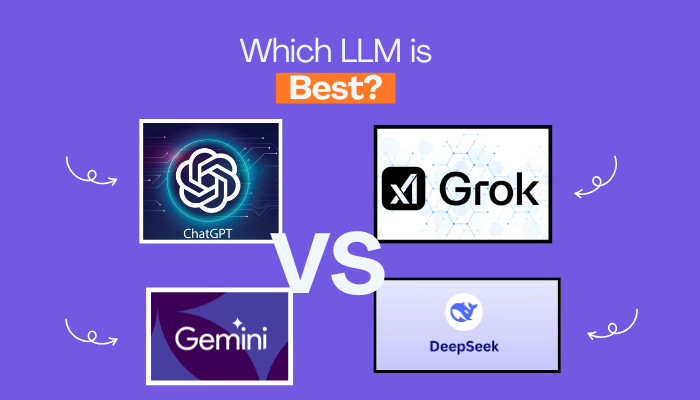
The rapid evolution of large language models (LLMs) has transformed how we interact with technology, enabling everything from casual conversations to complex problem-solving. As of March 26, 2025, four LLMs stand out in the competitive AI landscape: ChatGPT (by OpenAI), Grok (by xAI), Gemini (by Google), and DeepSeek (by DeepSeek AI). Each model offers distinct strengths, making the question “Which LLM is best?” highly contextual, depending on factors like reasoning, creativity, cost, multimodal capabilities, and accessibility. In this 2000-word analysis, we’ll compare these models in depth, provide a detailed comparison table, and critically evaluate their strengths and weaknesses to help you decide which LLM best suits your needs—whether you’re a student, developer, researcher, or business professional.
Understanding Large Language Models
Large language models are AI systems trained on vast datasets of text, enabling them to understand and generate human-like language. Built on architectures like transformers or mixture-of-experts (MoE), LLMs power applications such as chatbots, content generators, and coding assistants. Their performance depends on factors like training data, parameter count, and design focus (e.g., reasoning vs. creativity). ChatGPT, Grok, Gemini, and DeepSeek represent the forefront of this technology, each with unique approaches and capabilities. Let’s explore each model before comparing them head-to-head.
ChatGPT: The Versatile Veteran
ChatGPT, launched by OpenAI in November 2022, has become the benchmark for conversational AI. By 2025, it has evolved into advanced iterations like GPT-4o and the o1 family, with the latter optimized for reasoning. With a reported 59.5% market share, though growth has slowed to 8% quarterly, ChatGPT remains a dominant force due to its accessibility and versatility.
Strengths:
- Broad Capabilities: ChatGPT excels across diverse tasks—writing essays, coding in Python or JavaScript, solving math problems, and engaging in natural conversation. Its training on vast datasets ensures adaptability for general-purpose use.
- User-Friendly Ecosystem: Available in a free tier (GPT-3.5) and paid tiers (ChatGPT Plus at $20/month, Pro at $200/month), it’s accessible via web, mobile, and API. Features like image analysis, voice input, and plugin integration (e.g., Microsoft Office Copilot) enhance its utility.
- Reasoning Excellence: The o1 family scores 87.5% on ARC-AGI and excels in multi-step reasoning, making it a top choice for complex problem-solving in math, coding, and science.
- Polished Responses: Its output is coherent, well-structured, and human-like, ideal for professional or creative writing, such as storytelling or marketing copy.
Weaknesses:
- Cost Barrier: Advanced models like GPT-4o and o1-pro are expensive, with the Pro tier at $200/month, limiting access for budget-conscious users.
- Context Constraints: Its 128K-token context window (GPT-4-turbo) is robust but falls short of competitors like Gemini for massive documents.
- Real-Time Limits: While it offers web browsing, it struggles with real-time data retrieval compared to Gemini’s search integration or Grok’s X data.
- Occasional Errors: Hallucinations persist, especially in niche technical areas, and it lacks citations for research-focused tasks.
Use Cases: ChatGPT is ideal for generalists—students, writers, developers, and businesses needing a reliable, versatile AI assistant for creative writing, customer support, and general knowledge queries.
Grok: The Reasoning Rebel
Grok, developed by xAI and introduced in 2023, has quickly gained traction. By 2025, Grok 3 is its flagship model, marketed as the “smartest AI on Earth” with a focus on reasoning, truthfulness, and real-time insights, leveraging integration with the X platform.
Strengths:
- Top-Tier Reasoning: Grok 3 excels in technical benchmarks, scoring 95.8% on AIME (math), 84.6% on GPQA (science), and outperforming OpenAI’s o1 in blind tests with a 1400 ELO score in Chatbot Arena. Its DeepSearch and Think Mode enhance its reasoning capabilities.
- Real-Time Edge: Integration with X provides live data, making it ideal for current events and research. It can generate photorealistic images of public figures, like Joe Biden playing the piano, showcasing its unfiltered approach.
- Unfiltered Tone: Designed to be “maximally truth-seeking,” Grok avoids heavy censorship, delivering witty, concise answers that appeal to users seeking less sanitized responses. Its “roast me” feature adds a humorous twist.
- Image Generation: Native photorealistic image creation via Aurora sets it apart from ChatGPT’s reliance on DALL·E, though it’s not as advanced as open-source models like Flux.1.
Weaknesses:
- Limited Access: Exclusive to X Premium+ subscribers ($16–$50/month) or SuperGrok ($30/month), with no free tier, it’s less accessible than ChatGPT or DeepSeek.
- Context Size: Estimated at 128K tokens, it’s competitive but dwarfed by Gemini’s 2M-token capacity.
- Writing Depth: Long-form content lacks ChatGPT’s polish, often appearing as unrefined blocks of text, making it less ideal for creative writing.
- Potential Bias: Reliance on X data raises concerns about bias, though it strives for neutrality. It avoids taking definitive stances on controversial topics like Taiwan-China relations.
Use Cases: Grok suits researchers, coders, and X users needing technical precision, real-time insights, and creative visuals, particularly for math, science, and current-event analysis.
Gemini: The Multimodal Maestro
Google’s Gemini, evolved from Bard, is a family of LLMs launched in 2023. By 2025, Gemini 2.0 Pro and 1.5 Pro (with Deep Research) lead, leveraging Google’s search dominance and multimodal capabilities.
Strengths:
- Multimodal Mastery: Gemini processes text, images, audio, and video, outshining ChatGPT and Grok in multimedia tasks like image transcription, video analysis, and book recognition via photos.
- Massive Context: A 2M-token window in Gemini 2.0 Pro (roughly 1.5 million words) handles enormous documents, perfect for research or enterprise use, far surpassing the 128K-token limits of others.
- Search Power: Deep integration with Google Search offers real-time, accurate data, enhanced by Deep Research mode for comprehensive reports, making it ideal for academic and professional research.
- Productivity Boost: Ties to Google Workspace (Docs, Sheets) streamline workflows for Google ecosystem users, with features like Gemini Live for voice interaction.
Weaknesses:
- Reasoning Gap: Scoring 74.2% on MMLU, it trails Grok and ChatGPT in advanced math and coding tasks, with Gemini 2.0 Flash Thinking underperforming compared to OpenAI’s o1.
- Creative Limits: Responses can feel stiff compared to ChatGPT’s flair or Grok’s wit, reducing its appeal for creative writing or storytelling.
- Cost Structure: Advanced features require a $19.99/month Gemini Advanced subscription; free tiers (e.g., Gemini 2.0 Flash) are less capable.
- Cautious Tone: Like ChatGPT, it avoids controversial topics, such as political figures, which can frustrate users seeking unfiltered responses.
Use Cases: Gemini excels for multimedia creators, researchers, and businesses needing deep context, productivity tools, and real-time research capabilities.
DeepSeek: The Budget Innovator
DeepSeek, from China’s DeepSeek AI, debuted in 2025 with DeepSeek R1, a 671-billion-parameter MoE model. It’s a cost-effective disruptor challenging Western giants, quickly rising to the top of the U.S. iOS App Store.
Strengths:
- Affordability: Free to test, with paid tiers at $0.0008 per 1K tokens, it’s a fraction of competitors’ costs. Training at $5.5–$6 million (vs. GPT-4’s $60 million) reflects its efficiency.
- Technical Strength: Scores 90.8% on MMLU and rivals GPT-4 in coding and logic, with transparent chain-of-thought reasoning. It excels in math, logical reasoning, and technical tasks.
- Speed: MoE design delivers 384 tokens/second, outpacing all rivals, making it ideal for enterprise use and quick responses.
- Open-Source: Customizable weights appeal to developers, unlike closed models like ChatGPT, though it requires programming expertise.
Weaknesses:
- Writing Quality: Long-form output is technical but lacks ChatGPT’s polish, making it less suitable for creative writing.
- Context Size: 32K–128K tokens lag behind Gemini’s 2M, limiting its use for large documents.
- Text-Only: No multimodal features, unlike Gemini or Grok, restricting its use to text-based tasks.
- Regional Limits: Accessibility outside China varies, with restrictions in Australia, Taiwan, and South Korea due to security concerns. It avoids sensitive topics like Chinese politics, raising censorship issues.
Use Cases: DeepSeek is ideal for developers, startups, and technical users prioritizing cost, speed, and customization for coding and technical reasoning.
Comparison Table: ChatGPT vs. Grok vs. Gemini vs. DeepSeek
| Feature | ChatGPT (OpenAI) | Grok 3 (xAI) | Gemini (Google) | DeepSeek R1 (DeepSeek AI) |
|---|---|---|---|---|
| Developer | OpenAI | xAI | Google DeepMind | DeepSeek AI |
| Release | Nov 2022 (GPT-4o, o1 by 2025) | 2023 (Grok 3 by 2025) | 2023 (Gemini 2.0 by 2025) | Early 2025 |
| Reasoning | Excellent (87.5% ARC-AGI) | Superior (95.8% AIME, 84.6% GPQA) | Moderate (74.2% MMLU) | Very Good (90.8% MMLU) |
| Speed | Fast for general tasks | Quick with DeepSearch | Efficient with search | Fastest (384 tokens/sec) |
| Context Window | 128K tokens (~100K words) | 128K tokens (100K words) | 2M tokens (~1.5M words) | 32K–128K tokens (~25K–100K words) |
| Multimodal | Text + Images (via DALL·E) | Text + Image generation (Aurora) | Text, Images, Audio, Video | Text-only |
| Creativity | High (polished writing) | Moderate (witty, less refined) | Moderate (functional) | Low (technical focus) |
| Real-Time Data | Web browsing (decent) | X + DeepSearch (excellent) | Google Search (best) | Limited outside China |
| Cost | Free tier; $20–$200/month | $16–$50/month (no free tier) | $19.99/month (Advanced) | Free tier; $0.0008/1K tokens |
| Accessibility | Web, mobile, API | X platform, limited free access | Web, Google ecosystem | Web, API, open-source |
| Best For | General use, creativity | Technical reasoning, research | Multimodal, productivity | Cost-effective technical tasks |
Table Insights:
- Reasoning: Grok leads with superior performance in math and science, followed by ChatGPT and DeepSeek; Gemini lags in advanced reasoning.
- Speed: DeepSeek’s MoE efficiency makes it the fastest, with Grok and Gemini close behind for real-time tasks.
- Context: Gemini’s 2M-token window is unmatched, ideal for long-form analysis, while others are limited to 128K or less.
- Multimodal: Gemini dominates with full multimedia support, followed by Grok and ChatGPT; DeepSeek is text-only.
- Cost: DeepSeek offers the best value, while ChatGPT provides a balanced free-to-premium model.
In-Depth Comparison
Reasoning and Technical Performance
Grok 3 stands out as the reasoning champion, with a 95.8% score on AIME and 84.6% on GPQA, surpassing ChatGPT’s o1 (87.5% on ARC-AGI). Its DeepSearch and Think Mode allow it to tackle complex problems efficiently, taking 67 seconds to solve a logic puzzle compared to DeepSeek R1’s 343 seconds. ChatGPT’s o1 family is strong, particularly in STEM fields, but it lags slightly behind Grok in blind tests. DeepSeek R1, with a 90.8% MMLU score, excels in technical reasoning and coding, rivaling GPT-4, but its lack of multimodal support limits its versatility. Gemini, with a 74.2% MMLU score, struggles in advanced reasoning, making it less suitable for math or coding-heavy tasks.
Creativity and Writing
ChatGPT leads in creativity, producing polished, human-like text ideal for storytelling, marketing copy, and essays. Its verbose, formal style can be adjusted with guidance, making it versatile for creative tasks. Grok offers a witty, informal tone with pop culture references, but its long-form writing lacks refinement, better suited for casual or humorous exchanges. Gemini’s responses are functional but stiff, lacking the flair of ChatGPT or Grok, making it less ideal for creative writing. DeepSeek, with its technical focus, produces concise, accurate responses but struggles with creative or long-form content, often appearing mechanical.
Multimodal Capabilities
Gemini is the clear winner in multimodal tasks, supporting text, images, audio, and video. It can analyze photos, transcribe videos, and integrate with Google’s ecosystem, making it a powerhouse for multimedia creators. ChatGPT supports text and images via DALL·E, with limited video capabilities in Live Mode, but it’s not as seamless as Gemini. Grok offers text and image generation through Aurora, capable of photorealistic outputs, but lacks audio or video support. DeepSeek is text-only, a significant limitation for users needing multimedia functionality.
Real-Time Data and Research
Gemini excels in real-time data access, leveraging Google Search and Deep Research mode to provide up-to-date, comprehensive reports, ideal for academic research. Grok’s integration with X and DeepSearch makes it excellent for current events, offering fresh insights with minimal latency. ChatGPT’s web browsing is decent but less integrated, often struggling with the latest information. DeepSeek’s real-time capabilities are limited outside China, and its cautious approach to sensitive topics restricts its research utility.
Cost and Accessibility
DeepSeek is the most cost-effective, with a free tier and paid plans at $0.0008 per 1K tokens, making it accessible for startups and developers. ChatGPT offers a free tier (GPT-3.5) and paid plans ($20–$200/month), balancing accessibility and premium features. Gemini’s Advanced plan at $19.99/month unlocks its best features, but its free tier is less capable. Grok, limited to X Premium+ ($16–$50/month) or SuperGrok ($30/month), is the least accessible, with no free tier, restricting its user base.
Privacy and Security
ChatGPT, Gemini, and Grok offer privacy-focused modes, with ChatGPT allowing users to opt out of training data use, and Gemini and Claude ensuring data isn’t used for training. DeepSeek, however, lacks transparency in data storage practices, raising concerns, especially given its Chinese origin. Restrictions in countries like Australia and South Korea highlight these security risks, making it less suitable for users handling sensitive data.
Critical Evaluation
While benchmarks like MMLU and AIME provide a snapshot of performance, they don’t tell the whole story. Grok’s high scores may reflect xAI’s focus on specific tasks, but its reliance on X data could introduce biases, especially in politically charged topics. ChatGPT’s dominance in market share and versatility is undeniable, but its occasional hallucinations and high cost for premium features may deter some users. Gemini’s multimodal prowess and massive context window make it a research powerhouse, but its cautious tone and weaker reasoning limit its appeal for technical users. DeepSeek’s cost-efficiency and speed are impressive, but its text-only nature, regional restrictions, and censorship concerns raise red flags.
The narrative of Western dominance in AI, often pushed by companies like OpenAI and Google, is challenged by DeepSeek’s rise. Its ability to rival GPT-4 with a fraction of the budget suggests that innovation doesn’t always require massive resources, a point often overlooked in mainstream discourse. However, DeepSeek’s lack of transparency and potential for misuse as an open-source model warrant caution.
Which LLM is Best?
- ChatGPT: Best for versatility and creativity; a safe, broad choice for general users, writers, and businesses.
- Grok: Tops for technical reasoning and real-time research; ideal for coders, researchers, and X users.
- Gemini: Leads in multimodal tasks and productivity; perfect for multimedia creators and Google ecosystem users.
- DeepSeek: Wins on cost and speed; a budget-friendly option for technical users and developers.
Your choice depends on your priorities—test these models to find the best fit for your needs in this dynamic AI landscape!