
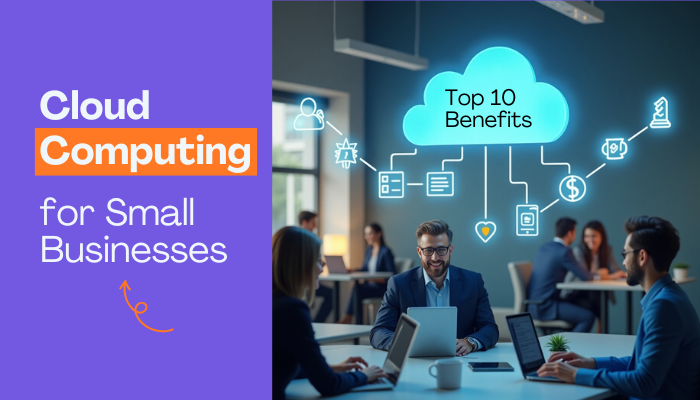
Small business owners rarely move to the cloud because it sounds exciting. They move because a server crashed, a laptop was stolen, a busy season overwhelmed the website, or a spreadsheet quietly became five different spreadsheets across five different laptops. If any of that sounds familiar, this guide is for you.
Below are the 10 concrete benefits of cloud computing for small businesses, backed by current adoption data, followed by a practical breakdown of what it costs and how to pick a plan that actually matches your business size instead of overpaying or underbuying.
Small Business Cloud Adoption at a Glance
- Small and medium businesses now report a cloud adoption rate of around 78%, and cost savings is the single most cited reason for making the move.
- SMBs that move to the cloud report roughly a 21% increase in profitability and about 26% faster growth compared to businesses still running everything on-site.
- The most-used cloud services among small businesses are email and productivity tools, backup and disaster recovery, and customer relationship management (CRM) software.
- Nearly half of small businesses plan to increase their cloud spending this year, a sign that early adopters are not walking it back after trying it.
What Cloud Computing Actually Costs vs. Traditional IT
The upfront math is straightforward. A physical server, the software licenses to run on it, and someone to maintain it easily runs into thousands of dollars before a small business processes a single order. Cloud infrastructure replaces that with a monthly plan, and organizations that shift workloads to the cloud report average IT maintenance cost reductions of around 16.7%.
For most small businesses, the realistic entry point is cloud VPS hosting rather than enterprise cloud platforms built for Fortune 500 budgets. As a reference point, Bisup’s cloud VPS plans start under $6 a month for a basic setup and scale up as traffic and resource needs grow, which is a realistic monthly cost comparison worth running against your current hosting or in-house server bill.
10 Benefits of Cloud Computing for Small Businesses
1. Lower Upfront Costs
Cloud computing replaces large capital purchases, servers, licenses, IT hardware, with a predictable monthly bill. You pay for the resources you actually use instead of buying capacity for a worst-case scenario that may never happen.
2. Scales With Demand
A retail site can add resources before a holiday sale and scale back down afterward. This flexibility is one of the biggest draws for seasonal and growing businesses, since capacity adjusts without a hardware purchase or a multi-week wait.
3. Work From Anywhere
Files, tools, and business systems live online rather than on one physical machine, so a team can operate from a home office, a storefront, or while traveling, using any device with an internet connection.
4. Less In-House IT Burden
The provider handles server maintenance, patching, and hardware failures. For a small business without a dedicated IT department, this removes one of the most common daily disruptions to running the actual business.
5. Easier Team Collaboration
Cloud-based tools let a team edit the same document, database, or project board at the same time, which eliminates the version-control confusion that comes from emailing files back and forth.
6. Stronger Security Than Most Small Businesses Can Build Alone
Reputable providers invest in firewalls, encryption, and monitoring at a level most small businesses could not replicate on their own budget. That said, security in the cloud is a shared responsibility. See our full breakdown in Cloud Computing Security: How to Keep Your Data Safe for what the provider covers and what still falls on you.
7. Built-In Backup and Disaster Recovery
Backup and disaster recovery is one of the top three cloud services small businesses use, and for good reason: a fire, flood, or stolen laptop no longer means losing the only copy of your business data. Read why backup is necessary for how to make sure your backup plan actually works when you need it.
8. Access to Enterprise-Grade Tools on a Small Business Budget
CRM systems, design software, and analytics platforms that used to be priced for large companies are now available through affordable monthly subscriptions, giving small businesses the same tools their bigger competitors use.
9. Lower Environmental Footprint
Large cloud data centers run at efficiency levels an individual small business server room cannot match. Moving to shared cloud infrastructure is a straightforward way to reduce the environmental impact of running your business online.
10. Faster to Launch, Faster to Compete
Cloud-native businesses report shipping new features roughly twice as fast as those still tied to on-premises infrastructure. For a small business, that speed difference is the gap between launching a promotion the same week you think of it and launching it a month later.
How to Choose the Right Cloud Plan for Your Business Size?
The benefits above only pay off if you pick a plan sized correctly for your business. Oversized plans waste money; undersized plans slow your site down during your busiest moments, which is exactly when it matters most.
- A small business website or blog typically needs 2 to 4 GB of RAM and a single vCPU core to run comfortably.
- An ecommerce store, booking system, or SaaS application usually needs 8 GB of RAM or more, since order processing and user accounts are more resource-intensive than static content.
- Look for NVMe SSD storage over older drive types; it directly affects how fast your site loads for visitors.
- Confirm the plan allows you to scale CPU, RAM, and storage up later without downtime, so growth does not mean a full migration.
| Plan | Best For | Starting Price* |
| Starter Cloud | Personal sites, portfolios, and light workloads just moving off shared hosting | From $5.17/mo |
| Growth Cloud | Small business websites, growing stores, and apps that outgrew shared hosting | From $21.84/mo |
| Enterprise Titan | High-traffic sites, SaaS products, and resource-intensive business applications | From $86.21/mo |
*Pricing shown reflects published rates at the time of writing on a 12-month term. Confirm current pricing and specifications on the live plan page before purchasing, since hosting prices and promotions change.
Common Mistakes Small Businesses Make When Moving to the Cloud
- Choosing the cheapest plan available without checking whether it can handle current traffic, then facing slowdowns during the first busy period.
- Skipping a migration plan and moving everything at once, which risks downtime during business hours.
- Assuming the provider handles all security, when most cloud security incidents actually come from misconfigured access and permissions on the customer’s side.
- Not testing backups after setting them up, only to discover during an actual emergency that the backup was incomplete.
If you are moving from shared hosting specifically, How to Migrate to Cloud Computing Without Downtime walks through a migration that will not interrupt customers while it happens, and When to Move From Shared Hosting to a VPS covers the specific traffic and performance signals that mean it is time to upgrade.
Ready to Move Your Business to the Cloud?
If your current hosting is holding your business back, Bisup’s cloud VPS hosting gives you dedicated vCPU, RAM, and NVMe storage that is not shared with other accounts, full root access, DDoS protection, and 24/7 monitoring, all backed by a 30-day money-back guarantee so you can try it without risk. Plans start under $6 a month and scale as your business grows, with free migration included if you are moving from another host.
The Real Payoff of Moving to the Cloud
The benefits of cloud computing for small businesses are not abstract. They show up as lower monthly costs, fewer 2 a.m. server emergencies, a team that can work from anywhere, and a business that can scale up during a busy season instead of turning customers away. The businesses seeing the biggest gains are not the ones with the biggest budgets; they are the ones that picked a plan sized for where they actually are today, with room to grow into tomorrow.
Frequently Asked Questions
Entry-level cloud VPS plans typically start under $10 a month, with mid-tier plans suited to growing small businesses in the $20 to $30 a month range. Enterprise-level plans with heavier resources can run $80 or more per month.
Usually yes for small businesses, since it removes the upfront hardware cost and reduces average IT maintenance spend. The exception is a business with very stable, predictable, high-volume workloads, where a fixed traditional server can sometimes work out cheaper long term.
A basic business website generally runs well on 2 to 4 GB of RAM. An online store, booking platform, or app with user accounts usually needs 8 GB or more. When in doubt, start with a plan that allows scaling up without downtime rather than overpaying for capacity you do not need yet.
Yes, with a proper migration plan. Files, databases, and DNS settings are typically moved and tested on the new environment before traffic is switched over, so visitors do not notice the transition.
Reputable providers secure the underlying infrastructure, but you are still responsible for configuring access permissions, encryption settings, and backups correctly. Security in the cloud is a shared responsibility, not something you can fully hand off.


