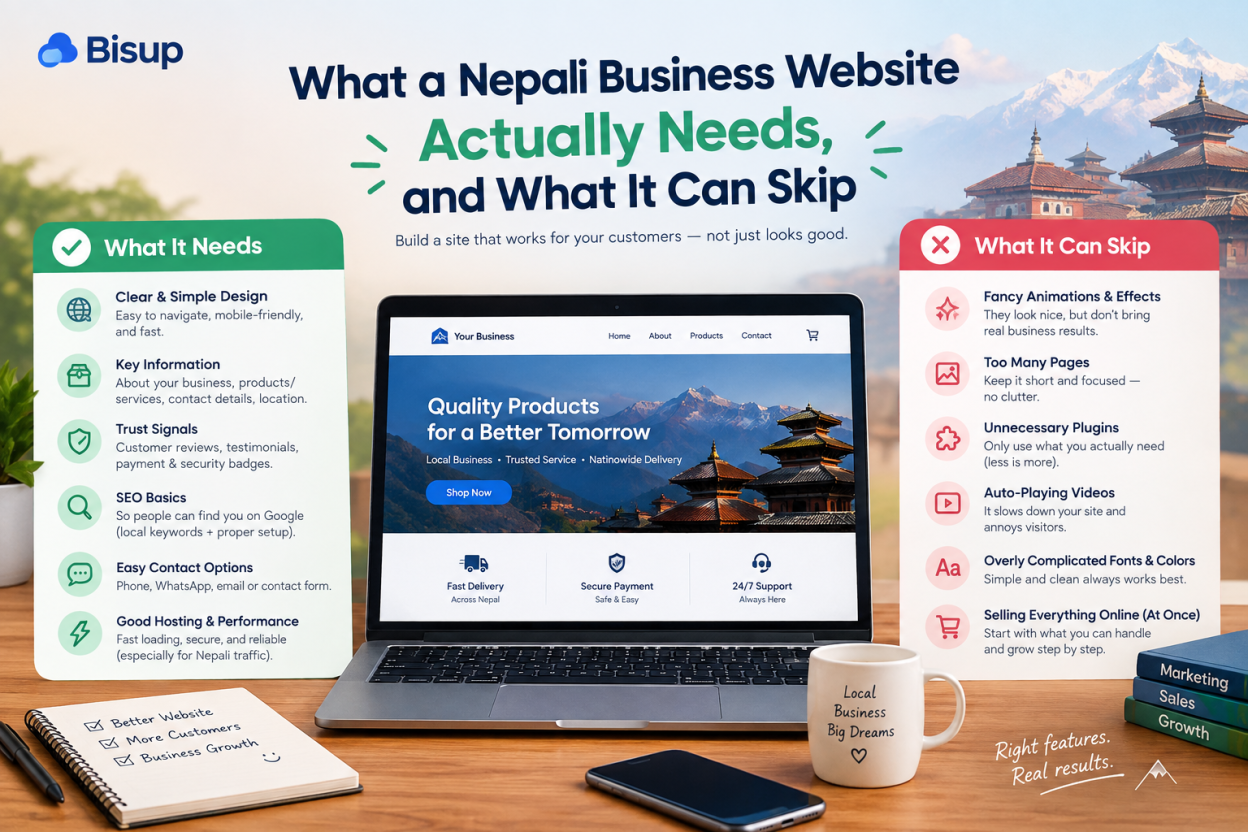
A website for business in Nepal needs five things: a home page that says what you do, a services page, a contact page with a phone number and WhatsApp, proof you are a real business, and a payment or enquiry route. Build it phone first, because that is how nearly all Nepali visitors will arrive.
Most advice on this subject is written for businesses in countries where customers search Google, read a long about page and fill in a contact form. Nepali customers behave differently, so the site that works here looks different too.
Let us start with the thing your website is genuinely competing against, because it is not another website.
Your real competitor is a Facebook page
Nepal had 14.8 million active social media user identities as of October 2025, equal to half the population, according to DataReportal’s Digital 2026 report for Nepal. Against 16.6 million internet users at the end of 2025, that means almost everyone online is on social media.
For a huge number of Nepali businesses, the Facebook page is the business online. It has photos, a phone number, reviews and messages. It costs nothing. Customers already live there.
So before spending on a website, be honest about what it adds that the page does not. Three things, usually:
- It works for people who search rather than scroll. A Facebook page rarely appears when someone types a service plus a location into Google.
- It holds information a page buries. Prices, specifications, service areas and documentation survive on a website. On a page they scroll away in a week.
- It signals permanence. For B2B, tenders, institutional clients and anyone comparing suppliers, a page alone reads as informal.
If none of those three apply to your business, a well-run Facebook page and a Google Business Profile may genuinely be enough for now. I would rather tell you that than sell you a site you do not need.
Do you need a website if you already have a Facebook page?
You need one when a customer’s decision requires more than a scroll. A restaurant taking orders through Messenger is fine without a site. A trekking agency handling foreign bookings, a school publishing results, or a supplier bidding for institutional contracts is not.
The clearest test is where your enquiries come from. If every enquiry arrives through Messenger from someone who already knows you, the page is doing the job. If you are losing work to competitors who appear in search, or fielding the same questions repeatedly because there is nowhere to point people, that is the moment.
The strongest setup is both. Keep the page for reach and conversation, and let the website carry the detail, the proof and the search visibility.
The pages a Nepali business site actually needs
Five pages. Not fifteen. A small site that is complete beats a large site that is half-built.
| Page | Why it earns its place | What most Nepali sites get wrong |
| Home | Says what you do and where, in the first screen | Slideshow of stock photos, no clear statement of the business |
| Services or products | Lets someone confirm you do the specific thing they need | One vague page covering everything |
| Contact | Phone, WhatsApp, physical location, map | Only a contact form, which many will not use |
| About | Establishes a real business with real people | Generic paragraphs about excellence and passion |
| Pricing or rate guide | Filters out enquiries you do not want | Omitted entirely, so every enquiry starts with cost |
The contact page deserves particular attention here. In Nepal, a contact form alone loses enquiries. Many customers will not type a message and wait for a reply. They want to call, or they want WhatsApp.
So put the phone number in the header as tappable text, not inside an image. Add a WhatsApp link that opens a conversation directly. If you have a physical location, embed a map, because directions in Kathmandu are landmark-based and a map saves everyone a phone call.
On pricing, the instinct in Nepal is to hide it and negotiate. That is a reasonable commercial choice, but understand its cost: every enquiry then starts with the price question, and you spend your day answering people who were never going to buy. Even a rate band filters that.
Build for the phone, not the desktop
This is the single biggest structural difference between a Nepali business site and the templates most agencies start from.
Nepal had 32.4 million cellular mobile connections in late 2025, equal to 109 percent of the population, and DataReportal notes 82.8 percent of those connections can be considered broadband. StatCounter put Android at 77.69 percent of Nepal’s mobile operating system market in February 2026.
Read that last figure again, because it has a practical consequence. Your site will mostly be seen on a mid-range Android phone, not the designer’s MacBook. Test it on one before launch. Actually hold the phone and use it.
What that changes in practice:
- Tap targets need to be large enough for a thumb, and spaced so a mis-tap does not dial the wrong thing.
- Heavy hero images and video backgrounds cost real money for visitors on mobile data. Compress everything.
- Text has to be readable without pinching. Small grey type on white is a common template default and a poor choice here.
- Forms should be short. Every extra field on a phone loses people.
Median fixed download speed in Nepal reached 79.79 Mbps at the end of 2025, up 11.4 percent year on year according to Ookla figures cited by DataReportal. Fixed broadband is genuinely decent now. Mobile data on a crowded evening is a different experience, and that is the one to design for.
Nepali, English, or both?
It depends who buys from you, and the honest answer for most businesses is both, with one of them leading.
If you sell to Nepali consumers, lead in Nepali. Trust and clarity matter more than international polish, and a customer reading their own language converts better.
If you sell to institutions, foreign clients or the diaspora, lead in English. Tender committees, international partners and trekking customers abroad all work in English.Running both properly is more than a translate button. Devanagari rendering, font selection and correct language markup all need handling, and a machine-translated Nepali version often reads worse
Payments and enquiries: how money actually reaches you
Nepal’s payment behaviour has shifted fast, and the numbers make the case better than argument does.
Nepal Rastra Bank indicators for mid-March 2026 showed 29,463,539 mobile banking users and 27,724,749 wallet users. In a single month there were 49,027,228 QR transactions worth NPR 125,915 million, while mobile banking handled 62,540,294 transactions worth NPR 540,763 million.
Two conclusions follow. QR has become the everyday habit, and mobile banking still carries the larger value. A business site that offers no digital payment path is now unusual rather than cautious.
That does not mean you need a full checkout. For a service business, a clear price and a QR code or wallet handle on the contact page is often enough. Full gateway integration is for businesses selling products online.
If you do need a checkout, our guide to accepting online payments in Nepal covers merchant approval, real fees and the verification step that stops people ordering without paying.
Keep cash on delivery for anything sold to consumers outside the major cities. It still converts better than any digital rail for a first-time buyer who has not bought from you before.
What you can safely skip
Every rupee spent on the list below is a rupee not spent on something that would have earned.
- A live chat widget nobody staffs. An unanswered chat is worse than no chat.
- A blog you will not maintain. Three posts from 2024 signal an abandoned business more clearly than having no blog at all.
- Elaborate animation and parallax effects. They cost load time on the mid-range Android your customers are actually holding.
- A newsletter signup with no newsletter behind it.
- Stock photography of foreign offices. Photos of your actual premises and staff build more trust than any stock library.
- A custom-built CMS. Standard platforms are cheaper to maintain and easier to hand to the next developer.
How much should a business website cost in Nepal?
Wide range, and the honest answer is that it depends on who builds it and how much is custom.
The recurring costs are the predictable part. A domain, hosting and an SSL certificate are annual and modest. The build is where quotes diverge, from a few tens of thousands of rupees for a template-based five-page site to several lakh for custom design with integrations.
Two things drive cost more than page count. Custom design rather than a well-chosen template, and integrations such as payment gateways, booking systems or bilingual content. A five-page template site with no integrations is genuinely inexpensive. The same five pages with a booking engine and two languages is a different project.
Ask any quote to separate build cost from annual running cost, and to state clearly who owns the domain. That second point matters more than people expect. A surprising number of Nepali businesses discover at renewal that their developer registered the domain personally.
Domain, hosting and the boring decisions
These get made in five minutes and then live with you for years, so make them deliberately.
On the domain, the choice is usually between a .com and a free .com.np. Both are defensible. The .com.np route signals a Nepali business and costs nothing, but requires documentation and approval, which our guide to registering a .com.np domain walks through. A .com is instant and travels better internationally.
On hosting, the question worth asking is where your customers are. A server closer to your audience means faster pages for them, and local billing means you pay in rupees through eSewa or Khalti rather than needing a card that works internationally.
Our web hosting in Nepal plans cover the ordinary business site. If you want the site designed as well as hosted, our website design and development service handles the build.
Whoever builds it, insist that the domain is registered in your business name, that you receive the hosting login, and that you get a copy of the files. Those three things are what let you change provider later without starting over.
Getting found once the site exists
A website nobody links to and nobody searches for is a brochure with a hosting bill.
Start with a Google Business Profile if you serve customers locally. For many Nepali service businesses it drives more enquiries than the website itself, and it costs nothing. Add your real address, opening hours, phone number and photos, and keep them accurate.
Make sure your business name, address and phone number match exactly across the website, the Google profile and your Facebook page. Inconsistency between those three is one of the most common and most easily fixed problems in Nepali local search.
Then write for the questions your customers actually ask. A page answering a specific question, in the words a Nepali customer would use, outperforms a generic services page in both search results and AI answers.
Frequently asked questions
For a local business whose customers already know it and message directly, often yes. A website earns its cost when you need to appear in search results, hold detailed information such as prices or specifications, or look established to institutional clients and foreign customers.
Five is usually enough: home, services or products, contact, about, and a pricing or rate guide. A complete five-page site outperforms a fifteen-page site with half the pages unfinished.
Lead in Nepali if you sell to Nepali consumers, and in English if you sell to institutions, foreign clients or the diaspora. Running both works well, but only with a real translation. A machine-translated Nepali version often reads worse than none.
Not necessarily. For a service business, a clear price with a QR code or wallet handle on the contact page is usually enough. Full gateway integration makes sense when you sell products online and want customers to complete a purchase without contacting you.
A .com.np signals a Nepali business and the registration is free, but it needs documentation and approval. A .com is instant and works better for international audiences. Businesses serving both often register the .com and add the .com.np later.
Your business, registered in your business name with your own contact details. If a developer registers it under their own name, changing provider later becomes difficult and occasionally expensive. Confirm this in writing before the build starts.