
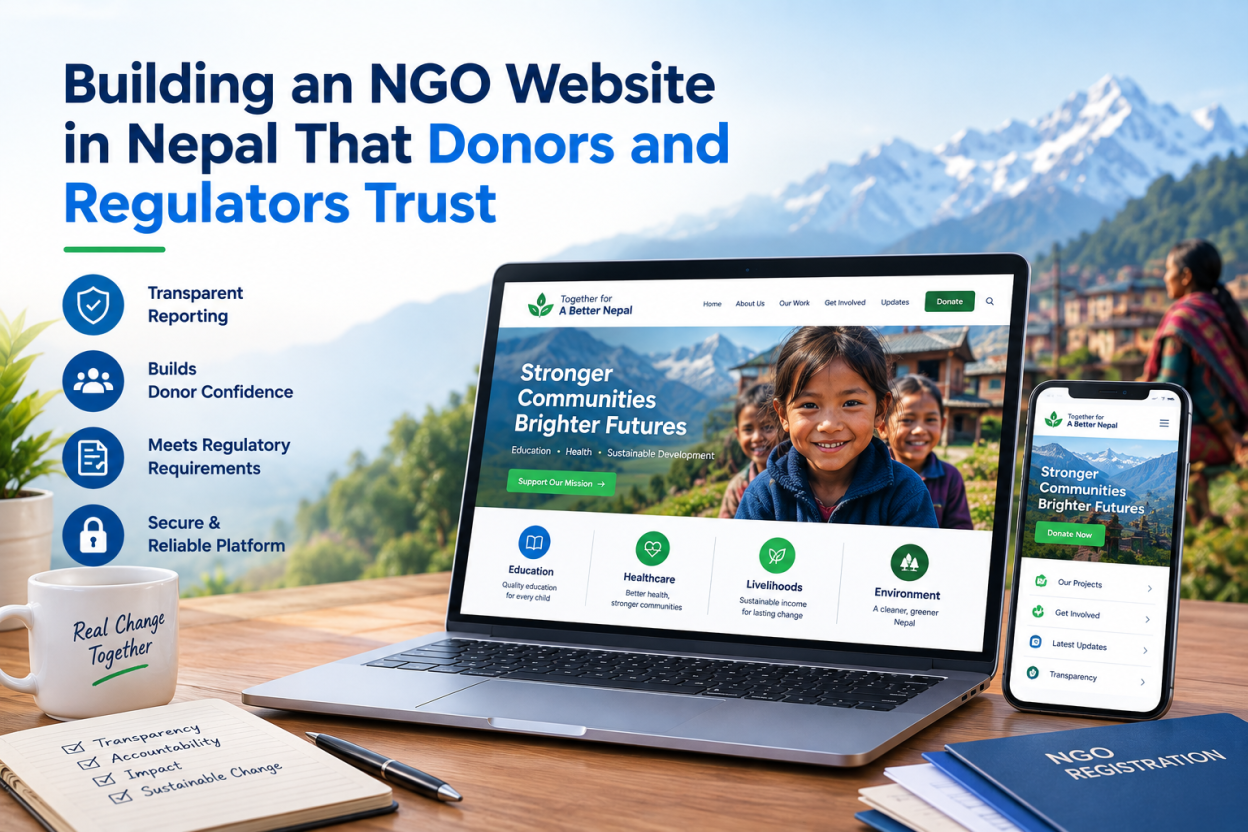
An NGO website in Nepal has to satisfy three audiences at once: donors who want evidence, communities who want information, and regulators who want your registration details visible. Publish your audited accounts and registration numbers, protect beneficiary identities carefully, and treat online donations as a compliance question rather than a plugin.
Nepal has one of the highest NGO densities in South Asia. The Social Welfare Council reported 50,358 registered NGOs as of 2019, with more than half of those in Bagmati Province, alongside hundreds of international organisations.That density is the problem your website exists to solve. A funder comparing organisations working on the same issue in the same district is looking for reasons to shortlist.
Your website has three audiences, not one
Most NGO sites are written for donors alone, which quietly fails the other two.
| Audience | What they came for | What loses them |
| Donors and funders | Evidence of results, governance, audited accounts | Vague impact language with no numbers or documents |
| Communities you serve | Programmes, eligibility, how to contact you | English-only content and jargon |
| Regulators and partners | Registration details, reporting, named officers | No registration numbers anywhere on the site |
The three do not conflict as much as people assume. A page that states your registration numbers, links your audited accounts and describes programmes in plain Nepali and English serves all three simultaneously. What fails all three is the page most Nepali NGO sites actually have: a mission statement, a photo gallery and a contact form.
Publish the documents people are already looking for
This is the fastest improvement available to almost any Nepali NGO website, and it costs nothing but a few uploads.
Registered organisations in Nepal already produce these documents. NGOs registered at the District Administration Office under the Association Registration Act renew annually, submitting an annual report, audited financial statements and tax clearance. Organisations affiliated with the Social Welfare Council submit financial statements, audit reports, project progress reports and donor funding details, and INGOs operate under general agreements with periodic renewal.
You are producing all of it for the regulator. Publishing it costs one afternoon and changes how serious your organisation appears.
What to put on the site:
- Your registration numbers, in full, in the footer or an about page. DAO registration, SWC affiliation and PAN where applicable.
- Audited financial statements for the last three years, as downloadable files.
- Your annual report, with actual numbers rather than adjectives.
- Your executive committee and senior staff, named, with roles.
- Your donors and funding partners, named, unless a specific agreement prevents it.
A note on numbers. Funders read impact claims with practised scepticism, and vague phrasing damages you more than modest figures would. Say you trained 412 people across nine wards in the year to Ashadh 2082, not that you empowered countless community members. The specific number is more credible precisely because it is unimpressive.
Beneficiary privacy is the thing most sites get wrong
This section matters more than everything else here, and it is almost never discussed in guidance about Nepali NGO websites.
Development work generates exactly the material that makes compelling donor content: photographs of identifiable people, personal stories of hardship, case studies of families and children. The instinct to publish it is understandable, because it moves donors. It also exposes people who often had little real power to refuse.
Practical standards to hold yourself to:
- Obtain informed consent that the person actually understood, in their own language, and record it. A signature on an English form is not informed consent.
- Never publish a child’s full name, school, ward and photograph together. Any two of those may be acceptable; all four identify a child to anyone who reads the page.
- Take particular care with survivors of violence, people living with stigmatised conditions, and anyone whose situation could expose them to harm in their own community. Change names, and say that you have.
- Remember that consent given in a difficult moment may not hold forever. Provide a way for someone to ask you to remove their story, and honour it without argument.
- Strip location metadata from photographs before uploading, since it can pinpoint a household.
There is a straightforward test. If the person in the photograph became your neighbour, your colleague or your employer in ten years, would they be comfortable that this page is still online and searchable? If not, do not publish it.
Organisations that visibly hold this line tend to impress serious institutional funders more than the emotive photograph would have. Safeguarding is something funders assess, and your website is the first evidence they see.
Is a donate button actually possible?
Harder than the plugin makes it look, and this is where general NGO website advice written for other countries misleads Nepali organisations badly.
Two separate problems stack here. First, Nepal is not a supported merchant country for the major global card gateways, so you cannot simply install a card checkout that accepts a donation from someone in Berlin. Domestic wallets serve Nepali donors well and are of no help to foreign ones.
Second, and more important, foreign funding for social welfare activity in Nepal is regulated. Organisations receiving foreign funds are expected to affiliate with the Social Welfare Council, and projects funded from abroad go through approvals rather than arriving as unrestricted transfers. A public donate button collecting foreign currency sits awkwardly against that framework.
None of this means you cannot raise money. It means the route matters:
- For Nepali donors, domestic wallets and QR payments work well and are straightforward.
- For foreign donors, most established Nepali organisations direct people to a partner or fiscal sponsor in the donor’s own country, which is also usually the only way the donor gets tax relief.
- For institutional funding, which is where most real money comes from, the website’s job is credibility rather than collection. No funder wires a grant through a website button.
Before adding any donation mechanism that accepts foreign money, take advice specific to your registration status. Getting this wrong creates a compliance problem that is far more expensive than the donations were worth.
The general routes for money arriving in Nepal from abroad, and the rules attached to them, are covered in our guide to accepting international payments in Nepal.
Should the site be in Nepali or English?
Both, and the reason is structural rather than aesthetic.
Your donors and institutional partners mostly read English. The communities you serve mostly read Nepali, or a regional language. An English-only NGO website quietly announces that its real audience is the funder, not the community, and increasingly funders notice that too.
A workable approach without doubling your workload: publish programme information, eligibility criteria, contact details and complaint procedures in Nepali, and publish reports, governance and financial documents in English. Then translate the handful of pages that genuinely need both.
Whatever you do, use a real translation. A machine-translated Nepali version of a page about a sensitive programme reads worse than no Nepali version at all, and community members will notice immediately.
If you work in a district where another language dominates, consider it for the pages that matter most to participants. Few organisations do this, and it is noticed by the people it is for.
What about the .org.np domain?
Worth having, and specifically appropriate for your organisation type.
The .np registry operates categories including .org.np for organisations, and registration is free for eligible bodies, though it requires documentation and approval. For a registered NGO in Nepal, that is a natural fit and signals a legitimate local organisation in a way a .com does not.
The trade-off is the same as elsewhere in the .np system. Approval takes documentation and time, whereas a .com or .org registers immediately. Many organisations register a .org first to launch, then add the .org.np when approval comes through, pointing one at the other.
The documentation process and what causes rejections is covered in our guide to registering a .com.np domain, and the same approach applies to the .org.np category.
What hosting an NGO actually needs
Modest, in most cases, and it would be dishonest to suggest otherwise.
A typical Nepali NGO site is informational: programme pages, reports, news and contact details. Traffic is low and steady rather than spiky. Standard shared hosting handles that comfortably, and the money saved is better spent on the translation and the annual report design.
Three things do matter more than raw capacity:
- Reliable backups, because your published reports and programme history accumulate into an institutional record you cannot easily recreate.
- An SSL certificate, which is basic credibility for an organisation asking people to trust it with information.
- Local billing, since paying a foreign host requires an international card that many Nepali organisations do not hold, and procurement rules may prefer a local vendor with a proper invoice.
Frequently asked questions
Registration numbers, audited financial statements for recent years, an annual report with real figures, named executive committee members and staff, named funding partners, and programme information in Nepali. Most organisations already produce all of this for regulators and simply never upload it.
Only with informed consent given in the person’s own language and recorded. Never combine a child’s full name, school, ward and photograph on the same page. Take particular care with survivors of violence or anyone who could face harm in their community, and provide a way for someone to withdraw their story later.
Both. Publish programme information, eligibility and complaint procedures in Nepali for the communities you serve, and governance and financial reporting in English for funders. Use a real translation rather than a machine-translated page.
Eligible organisations can register in the .org.np category, which is free but requires documentation and approval. Many organisations launch on a .org and add the .org.np once approval comes through.
Little. A typical NGO site is informational with steady low traffic, so standard shared hosting is sufficient. Prioritise reliable backups, an SSL certificate and a provider who can issue a proper local invoice for your procurement records.

