If your website has outgrown shared hosting but you’re not ready for an expensive dedicated server, VPS hosting may be exactly what you need.
Whether you’re launching an online store, running a business website, hosting multiple WordPress sites, or developing custom applications, choosing the right hosting can directly affect your site’s speed, security, and reliability.
In this guide, you’ll learn what VPS hosting is, how it works, when you should upgrade, and how to choose the best VPS plan in 2026. We’ll also explain how VPS hosting differs from shared hosting and dedicated servers so you can make a confident decision.
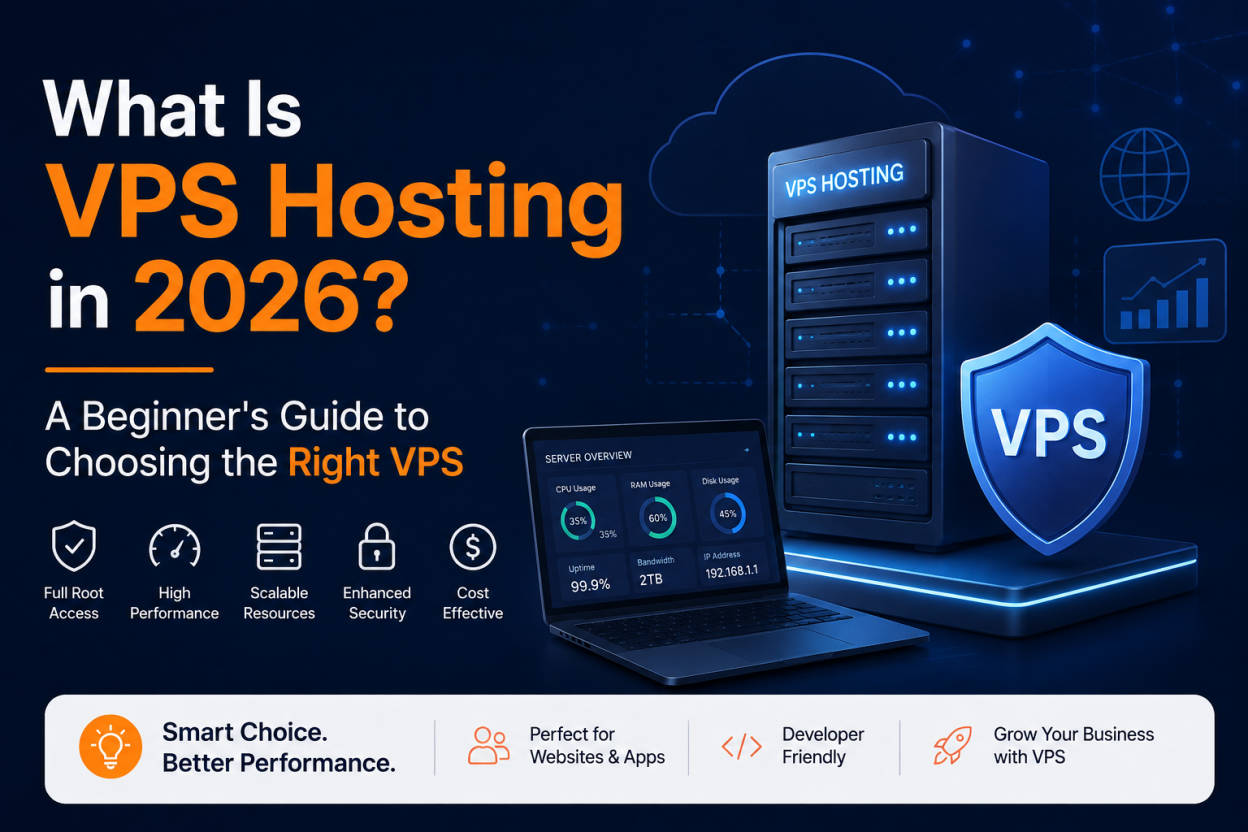
What Is VPS Hosting in 2026? A Beginner’s Guide to Choosing the Right VPS
VPS hosting in 2026 has become the go-to choice for website owners who have outgrown shared hosting but are not ready for a full dedicated server. A VPS, or virtual private server, gives you a private slice of a physical machine with your own CPU, RAM, and storage. You get more power, more control, and more privacy, without paying for an entire server.
If you have ever wondered what VPS hosting actually means, or why so many bloggers, developers, and small business owners are switching to it this year, you are in the right place. This guide breaks down VPS hosting in plain language, using real 2026 data, so you can choose the right plan with confidence.
What Is VPS Hosting?
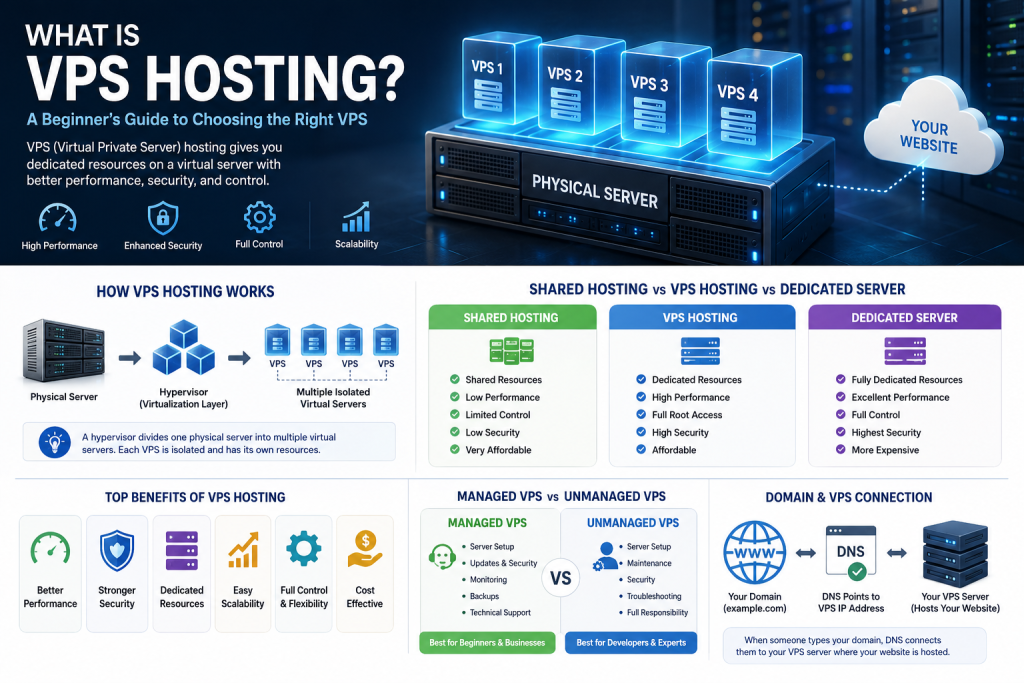
VPS hosting is a type of web hosting that uses virtualization technology to split one physical server into several isolated virtual servers. Each virtual server acts like its own independent machine, complete with a dedicated operating system, guaranteed resources, and root access.
Unlike shared hosting, where hundreds of websites compete for the same CPU and memory, a VPS gives you a fenced-off portion of resources that nobody else can touch. This setup is often called KVM virtualization, short for Kernel-based Virtual Machine, and it is now the industry standard because it keeps each server instance completely separate at the hardware level.
Think of an apartment building. Shared hosting is like renting a bed in a hostel dorm room, where you share everything with strangers. A VPS is like renting your own apartment inside that building. You share the building’s foundation and utilities, but your unit, your space, and your rules stay yours alone. A dedicated server, by comparison, is like owning the entire building.
According to recent market research, the global VPS hosting market is forecasted to reach about 6.4 billion dollars in 2026, growing at a compound annual growth rate of 11.9 percent. That growth reflects a simple trend: businesses want more control over their infrastructure without the higher cost of dedicated hardware.
How Does VPS Hosting Work in 2026?
A VPS works through a layer of software called a hypervisor, which sits on top of a physical server and divides it into multiple virtual environments. Each environment behaves like an independent server with its own operating system, files, and applications.
In 2026, most providers combine this virtual machine layer with lightweight containers for individual apps, creating a dual-layer security model. Even if a container is somehow breached, the underlying hypervisor still enforces strict memory and process separation between tenants. This blended approach is quickly becoming the standard deployment pattern across the hosting industry.
Modern VPS plans also run on solid-state storage rather than older spinning disks. NVMe SSD storage now dominates the VPS market and delivers input and output speeds up to four times faster than older storage types, which translates into quicker page loads and snappier database queries for your visitors.
Managed vs. Unmanaged VPS
Before you buy a plan, you need to understand the two main flavors of VPS hosting.
Unmanaged VPS hands you full root access and full responsibility. You handle server setup, security patches, software updates, and troubleshooting yourself. This option suits developers and system administrators who want maximum control.
Managed VPS puts the technical workload on the provider’s team. They handle server configuration, monitoring, backups, and security updates for you. Managed VPS hosting is becoming increasingly popular for its expert management, control, and performance, especially among small businesses that lack an in-house IT team.
If you are unsure which fits your project, our shared hosting vs VPS comparison guide can help you decide before you commit to a plan.
VPS Hosting Statistics and Market Data for 2026
Numbers tell the real story of where VPS hosting stands today. Here is what the data shows heading into the second half of 2026.
- VPS hosting now captures roughly 25.38 percent of the overall web hosting market, reflecting rising demand for scalable, dedicated resources.
- BuiltWith recorded over 10.3 million VPS hosting technology detections across the internet in July 2026, with DigitalOcean identified as the most detected VPS provider.
- More than 90 percent of VPS users say they would recommend it, and 61 percent would recommend it even to non-technical friends, a sign that VPS management has become far more beginner-friendly.
- Hosting providers now rank VPS and dedicated hosting as their single biggest growth opportunity for 2026, ahead of both shared hosting and standard cloud servers.
These figures matter because they show VPS hosting is not a niche product anymore. It has become a mainstream stepping stone between budget shared hosting and expensive dedicated infrastructure.
Why Businesses Are Moving to VPS Hosting
Website owners upgrade to VPS hosting for a handful of practical reasons, and most of them come down to performance, security, and long-term cost savings.
Consistent, Predictable Performance
On shared hosting, a traffic spike on someone else’s site can slow yours down too. This is often called the noisy neighbor problem. A VPS eliminates that risk because your CPU and RAM allocation belongs to you alone, so your site keeps running smoothly even during high traffic.
Stronger Security and Isolation
KVM-based isolation creates fully independent virtual machines on a single physical host, so each instance runs in a completely separate environment with no shared kernel dependencies. That separation makes it much harder for a security issue on one VPS to spread to another.
Data shows that more organizations moved away from shared hosting plans between 2024 and 2026 than in the previous five years combined, largely because of stricter data protection rules and rising uptime expectations. If your site handles customer data, payments, or logins, that added isolation is not optional anymore.
Room to Scale
A VPS lets you scale CPU, RAM, and storage up or down as your traffic grows, usually within minutes and without migrating to a new server. This flexibility matters for seasonal businesses, growing SaaS products, and stores that expect a holiday traffic surge.
Better Value Than Dedicated Servers
Dedicated servers generally start around 100 dollars per month, with fully managed plans costing significantly more. A VPS delivers a large share of that performance and control for a fraction of the price, which is why so many growing sites treat it as the natural next step after shared hosting. For a deeper cost breakdown, check our web hosting pricing guide.
Key Features to Look for in a VPS Plan
Not all VPS plans are built the same. Before you buy, compare providers against these core features.
NVMe SSD Storage
Confirm the plan uses NVMe storage rather than older SATA SSDs. NVMe SSDs as standard, along with built-in DDoS protection, instant deployment, and multi-location data centers, define the baseline VPS experience in 2026.
Root Access and Full Control
A true VPS should give you root or administrator access, letting you install custom software, configure firewalls, and fine-tune server settings to match your specific workload.
Built-In DDoS Protection
Cyberattacks keep growing more sophisticated, so look for a provider that bundles DDoS mitigation into the base plan rather than charging extra for it.
High Availability Architecture
Avoid providers that run your VPS on a single physical server with local-only storage. A single-server deployment with no redundancy leaves you one hardware failure away from extended downtime, so ask whether your provider offers redundant, high-availability infrastructure.
Data Center Locations
Choose a data center close to your target audience to reduce latency. Providers with a dozen or more global locations make this easier, especially if you serve customers across multiple regions.
Backup and Migration Support
Free automated backups and free migration assistance save you time and reduce the risk of losing data during setup.
Linux vs. Windows VPS: Which Should You Choose?
Most VPS plans let you pick between a Linux or Windows operating system, and the right choice depends on your software stack.
Linux VPS works well for WordPress sites, PHP applications, Node.js projects, and most open-source software. It tends to cost less because there is no licensing fee involved.
Windows VPS makes sense if your project depends on .NET applications, Microsoft SQL Server, or specific Windows-only software. Expect a higher monthly cost due to licensing.
If you are building a typical website or blog, a Linux VPS is usually the simpler, cheaper, and more flexible starting point.
How to Choose the Right VPS Plan: A Step-by-Step Checklist
Picking a VPS plan feels overwhelming at first, but breaking it into steps makes the decision much easier.
- Estimate your traffic and resource needs. A small blog might run comfortably on 2 GB of RAM, while an ecommerce store or SaaS app may need 8 GB or more.
- Decide between managed and unmanaged. Choose managed if you lack server administration experience, and unmanaged if you want full control and already know Linux basics.
- Check the storage type. Prioritize NVMe SSD storage over standard SSD or HDD for faster load times.
- Compare uptime guarantees. Look for a service level agreement of at least 99.9 percent uptime.
- Review security features. Confirm the plan includes DDoS protection, regular backups, and firewall options.
- Test customer support. Reach out with a pre-sales question and see how quickly and clearly the team responds.
- Read the renewal pricing. Many providers offer a discounted first term, so always check what the plan costs after renewal.
This checklist works for beginners and experienced site owners alike, and it pairs well with our step-by-step website migration guide if you are moving from shared hosting.
Common VPS Hosting Mistakes to Avoid
Even experienced users make these mistakes when choosing or managing a VPS.
- Underestimating resource needs. Buying the cheapest plan available often backfires once real traffic arrives.
- Skipping backups. Automated backups are not optional, especially on unmanaged plans where you control everything.
- Ignoring renewal pricing. Introductory discounts can make a plan look far cheaper than it actually is long term.
- Choosing unmanaged VPS without the skills to run it. Unmanaged hosting demands real Linux or Windows server knowledge, so be honest about your comfort level.
- Overlooking data center location. Hosting your VPS far from your audience adds unnecessary latency and can hurt page speed and search rankings.
VPS Hosting Trends Shaping 2026
VPS hosting keeps evolving, and a few trends stand out this year.
AI-driven server management. AI-powered automation is helping providers optimize performance and strengthen security across managed VPS plans, reducing the manual work site owners once had to handle themselves.
GPU-enabled VPS instances. By 2026, VPS instances with dedicated GPU capacity are showing up across numerous provider offerings, letting businesses run demanding workloads without buying expensive on-premise hardware.
Developer-first tooling. Providers are focusing more on full API access, Git integrations, and CI/CD support, making it easier for development teams to automate deployments straight from a VPS.
Sustainability initiatives. More providers now run energy-efficient hardware and renewable-powered data centers, appealing to environmentally conscious businesses.
Together, these shifts show a hosting market that is maturing quickly, moving VPS hosting from a niche technical product into an approachable option for everyday website owners.
Frequently Asked Questions About VPS Hosting
Is VPS hosting good for beginners?
Yes, especially if you choose a managed VPS plan. Managed hosting handles server setup, security, and maintenance for you, so you get the performance benefits of a VPS without needing deep technical knowledge.
How much does VPS hosting cost in 2026?
Entry-level VPS plans typically start around 5 to 10 dollars per month, while higher-resource or fully managed plans can cost 40 dollars or more per month. Pricing depends on RAM, storage, CPU cores, and whether the plan is managed or unmanaged.
What is the difference between VPS and cloud hosting?
A traditional VPS usually runs on a single physical server that has been split into virtual machines. Cloud hosting spreads your resources across multiple interconnected servers, which often improves reliability since there is no single point of hardware failure.
Can I upgrade my VPS plan later?
Most providers let you scale your VPS resources, such as RAM, storage, and CPU cores, with just a few clicks and minimal downtime. This flexibility is one of the main reasons businesses choose VPS hosting over a fixed dedicated server.
Do I need technical skills to manage a VPS?
For unmanaged VPS, yes, you need comfort with the command line and basic server administration. For managed VPS, the provider’s support team handles most technical tasks, so beginners can still use a VPS confidently.
Is VPS hosting more secure than shared hosting?
Generally, yes. A VPS isolates your resources and files from other users on the same physical machine, which reduces the risk of one compromised account affecting your site.
Final Thoughts
VPS hosting in 2026 sits at a sweet spot between affordability and performance. It gives beginners a realistic path to more power and control, without the steep learning curve or price tag of a dedicated server. Whether you pick a managed plan for simplicity or an unmanaged plan for full control, understanding what a VPS actually offers puts you in a strong position to choose the right host for your project.
If you are ready to compare specific providers, take a look at our best VPS hosting providers guide for hands-on recommendations based on price, performance, and support quality.