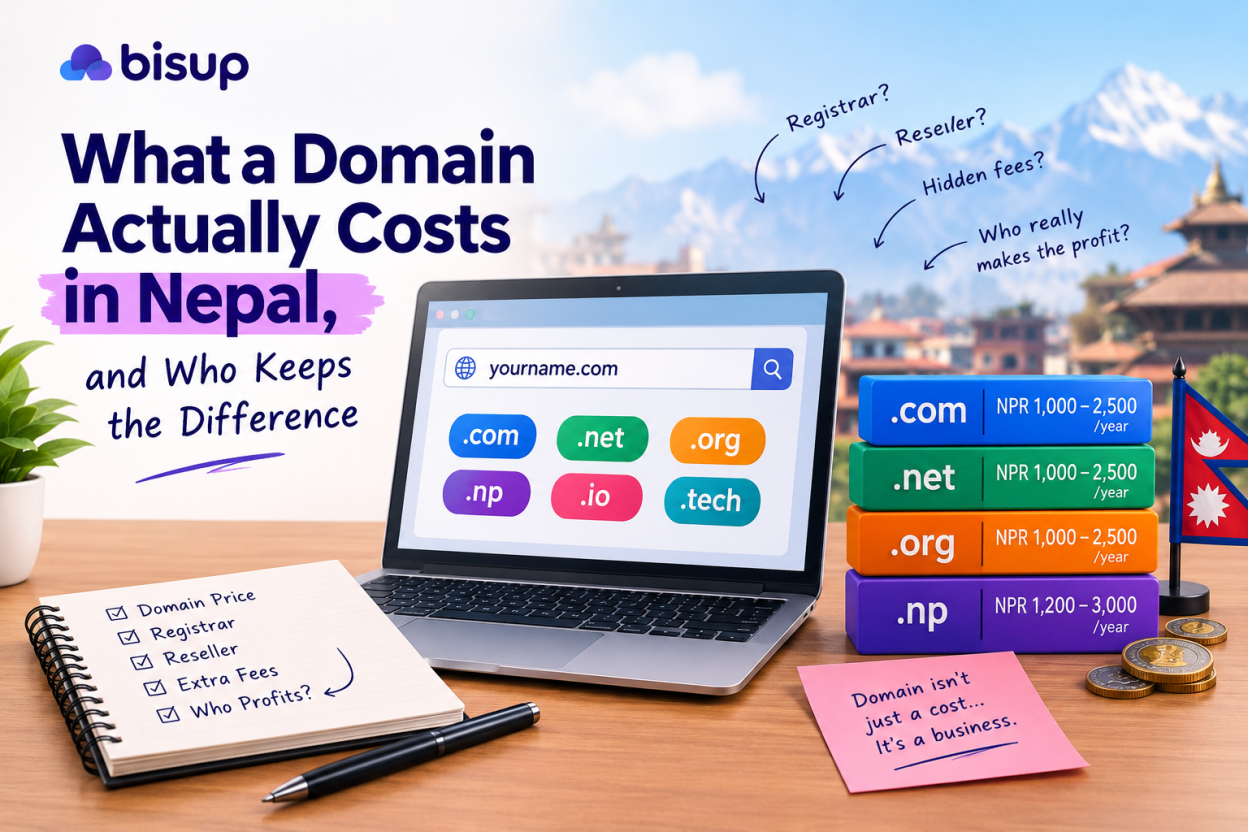
Domain prices in Nepal split into two worlds. The .np extensions, including .com.np, are free from the national registry. A .com carries an underlying industry cost of roughly USD 10.46 a year, rising to about USD 11.17 on 1 November 2026, with everything above that being registrar margin
Almost nobody selling you a domain explains what sits underneath the price, so comparing offers in Nepal feels like guesswork. It is not. The underlying cost is published, and once you know it, the differences between registrars become easy to read.
What a .com costs before anyone marks it up
Three parties sit behind every .com registration, and only one of them sets a price you can look up.
Verisign operates the .com registry and charges every accredited registrar the same wholesale fee, currently USD 10.26 per year for a new registration or renewal. ICANN adds a transaction fee of USD 0.20 per annual increment. That puts the underlying industry cost at roughly USD 10.46 a year before any registrar adds anything.
Everything above that figure is the registrar’s margin, operating cost and profit. That is not illegitimate, since running a registrar costs money and support has value. But it explains why prices vary so widely for a product that is identical wherever you buy it.
For scale, one large international registrar has listed standard .com renewal pricing at USD 22.99, more than double the underlying baseline. A .com from one seller is exactly the same domain as a .com from another. You are choosing a service and a price, not a better domain.
Our own published NPR pricing is calculated at a stable rate of 1 USD to Rs. 145. On that basis a .com is Rs. 1,884 to register and Rs. 2,174 to renew, which works out at about USD 13.00 and USD 14.99 respectively. We are showing you our own numbers because a pricing article that hides them is not worth reading.
| Layer of the .com price | Now | From 1 Nov 2026 |
| Registry fee charged to every registrar | USD 10.26 per year | USD 10.97 per year |
| ICANN transaction fee | USD 0.20 | USD 0.20 |
| Underlying industry cost | About USD 10.46 | About USD 11.17 |
| Registrar margin and costs | Varies enormously | Varies enormously |
| What you actually pay | Whatever your registrar lists | Whatever your registrar lists |
Against that baseline, here is what we actually charge, taken from our own domain pricing page. Registration, transfer and renewal are priced separately, and grace and redemption terms differ by extension.
| TLD | New (NPR) | Transfer | Renewal | Grace period |
| .com.np | Free | n/a | Free | Reverification applies |
| .com | Rs. 1,884 | Rs. 2,465 | Rs. 2,174 | 5 days (Rs. 435 restore) |
| .org | Rs. 1,884 | Rs. 2,465 | Rs. 2,174 | 5 days (Rs. 435 restore) |
| .net | Rs. 2,464 | Rs. 2,464 | Rs. 2,464 | 30 days (no fee) |
| .biz | Rs. 3,783 | Rs. 3,783 | Rs. 3,783 | 30 days (no fee) |
| .xyz | Rs. 725 | Rs. 1,304 | Rs. 1,304 | 30 days (no fee) |
| .co | Rs. 3,769 | Rs. 4,784 | Rs. 4,784 | 30 days (no fee) |
| .io | Rs. 6,525 | Rs. 8,554 | Rs. 8,554 | 30 days (no fee) |
| .ai | Rs. 15,818 | Rs. 20,299 | Rs. 20,299 | 30 days (no fee) |
Two things in that table are worth reading closely, and both are covered in the sections below: the gap between the new price and the renewal price, and the grace period, which on a .com is far shorter than people assume.
The price is going up on 1 November 2026
This is the time-sensitive part, and it is worth acting on if you hold .com domains.
Verisign has notified registrars that the wholesale .com fee rises from USD 10.26 to USD 10.97 on 1 November 2026, an increase of USD 0.71 or roughly 6.9 percent. It is the first change since September 2024. With the ICANN fee included, the underlying annual cost moves to about USD 11.17.
Your registrar may pass the increase through in full, absorb part of it, or change its retail price by a different amount. The wholesale figure is not a checkout price.
The hedge is simple and available to everyone. Because the registry fee is charged per annual increment, renewing or extending before the change locks in the current rate for every year you add. A five-year renewal completed after the cutover carries five years at the higher fee; the same renewal completed before it does not.
Longer term, the direction is clear. Under the current agreement Verisign may raise the wholesale price by up to 7 percent a year during the final four years of each six-year term. Reporting notes that if it uses the maximum every year, wholesale could reach around USD 13.42 by the time the present term ends in 2030.
So if you are certain you will keep your main business domain, multi-year renewal is a straightforward saving rather than a gamble.
The same logic applies to hosting renewals, which we cover in our piece on web hosting renewal price increases.
Why is renewal more expensive than registration?
Because the first year and every year after it are priced by different logic, and only one of them is competitive.
Registrars discount heavily to win the initial sale, sometimes to the point of making essentially no margin at all, then recover profit on renewals once you are committed. Moving a domain later is possible but requires effort, and registrars know most people will not bother.
On some extensions the registry itself sets a lower wholesale rate for new registrations than for renewals, so even a registrar adding no markup would still show a jump.
None of this is a scam, and treating it as one leads people to the wrong conclusion. It is a pricing model, and it is something to check before you buy rather than after the invoice arrives.
The practical rule: ignore the first-year price entirely when comparing. Ask what the renewal costs, find that figure on the registrar’s own site rather than in an advertisement, and compare on that. A domain you keep for five years is priced by year two onwards.
Since we are making this argument, it is only fair to show our own gap. A .com with us is Rs. 1,884 new and Rs. 2,174 on renewal, an uplift of about 15 percent. A .net is Rs. 2,464 whether you are registering, transferring or renewing, so there is no uplift at all. Compare that with a renewal priced at more than double the underlying cost and you can see the range the market covers.
A 15 percent step from a promotional first year to a steady-state price is a different thing from a 100 percent one. Judge any registrar on the size of that step, including us.
The free .np extensions change the maths
Nepal has an advantage here that most countries do not, and it is worth taking seriously before paying for anything.
The .np categories, including .com.np, .org.np and .net.np, are free through the national registry. There is no registration fee and no renewal fee. Compared with a .com at roughly USD 11 a year underlying, plus whatever margin, that is a genuine saving repeated annually.
The trade-offs are not financial. Documentation and approval are required, the name must correspond to your registration documents, and the extension you may use is tied to your entity type. There is also a reverification process to stay on top of.
Those rules are covered in our guide to whether a .com.np is really free, and the choice between the two extensions in our comparison of .com.np and .com.
For a business serving Nepali customers, the free option is often genuinely the better choice rather than merely the cheaper one. For a business selling abroad, paying for a .com is usually worth it for reasons that have nothing to do with price.
Paying from Nepal costs more than the sticker price
A dollar price is not a dollar price when you are paying from Kathmandu, and international comparisons never account for this.
Three costs sit on top of the advertised figure. Currency conversion, which your card issuer applies at its own rate. The requirement to hold an international card at all, which many Nepali businesses and individuals do not. And the friction of outward payment, which turns a routine annual renewal into something that can quietly fail.
That last one is the expensive one. A renewal that fails because a card was declined does not announce itself. You find out when the site goes down.
Buying through a Nepali registrar that bills in rupees and accepts local payment methods removes all three. The listed price may look higher than a discounted international offer, and the total cost of keeping the domain for five years frequently is not.
Weigh it honestly rather than by sticker price. If you can reliably pay an international registrar and prefer it, that is a legitimate choice. If your renewal depends on one person’s personal card, that is a risk sitting on your business’s main asset.
If local billing suits you, our domain registration service covers both the paid extensions and the free .np categories.
The costs nobody quotes
Four charges that appear after the purchase decision has been made.
- Late recovery, and the grace period is shorter than you think. On our .com and .org registrations the grace period is 5 days with a Rs. 435 restore fee, followed by a redemption window of 2 days carrying a further Rs. 435 fee. A .net or .biz allows 30 days grace at no fee. Internationally, redemption recovery is often quoted at USD 80 to 150. Check the grace period on your specific extension rather than assuming a month.
- WHOIS privacy. Included free by some registrars and billed annually by others. Worth having, and worth checking whether you are paying for it.
- Transfer timing. ICANN policy requires a domain to be at least 60 days old before it can move between registrars, so you cannot simply buy a cheap first year and transfer away immediately.
- Multi-year commitment. Locking in a rate is only a saving on a domain you will actually keep. Registering five years of a speculative project name is not a hedge, it is a purchase.
On the first point, the fix costs nothing. Enable auto-renewal, keep the email address on the domain current and monitored, and set a calendar reminder a month before expiry as a backup. Losing a domain to an unread renewal notice is the most avoidable expensive mistake in this entire subject.
So what should you actually pay?
A short decision guide.
- If you serve Nepali customers and can meet the documentation requirements, start with a free .np extension. Nothing you pay will serve that audience better.
- If you need a .com, compare on renewal price rather than first-year price, and confirm it on the registrar’s own website.
- If you hold .com domains you intend to keep, consider renewing before 1 November 2026 to lock in the current registry rate for the added years.
- If paying internationally is awkward from Nepal, weigh a local registrar on total cost and reliability rather than on the advertised figure.
- Whatever you choose, enable auto-renewal and put a real, monitored email address on the record.
A domain is among the cheapest things your business owns and among the most expensive to lose. The money question is worth ten minutes. The renewal question is worth a calendar entry.
Frequently Asked Question
The underlying industry cost is about USD 10.46 a year, made up of a USD 10.26 registry fee and a USD 0.20 ICANN fee, rising to roughly USD 11.17 from 1 November 2026. What you pay depends on your registrar’s margin, and retail prices vary widely for an identical product.
Yes, with no registration or renewal fee through the national registry, which is unusual internationally. The costs are documentation, approval time, and a name that must correspond to your registration papers. There is also a reverification process to keep on top of.
Registrars discount the first year heavily to win the sale, then price renewals closer to their real cost plus margin. On some extensions the registry also charges more for renewals than new registrations. Always compare on the renewal price.
If you are certain you will keep it, there is a case for it. The registry fee is charged per annual increment, so extending before 1 November 2026 locks in the current rate for every year added. It is only a saving on a domain you would have renewed anyway.
On sticker price, often international. On total cost, frequently not, once currency conversion, the need for an international card and the risk of a failed renewal are counted. Compare over several years rather than on the first-year figure.
There is usually a grace period at the normal rate, after which the domain enters redemption and recovery carries a substantial additional fee. After that it can be released for anyone to register. Enable auto-renewal and keep a monitored email address on the record.