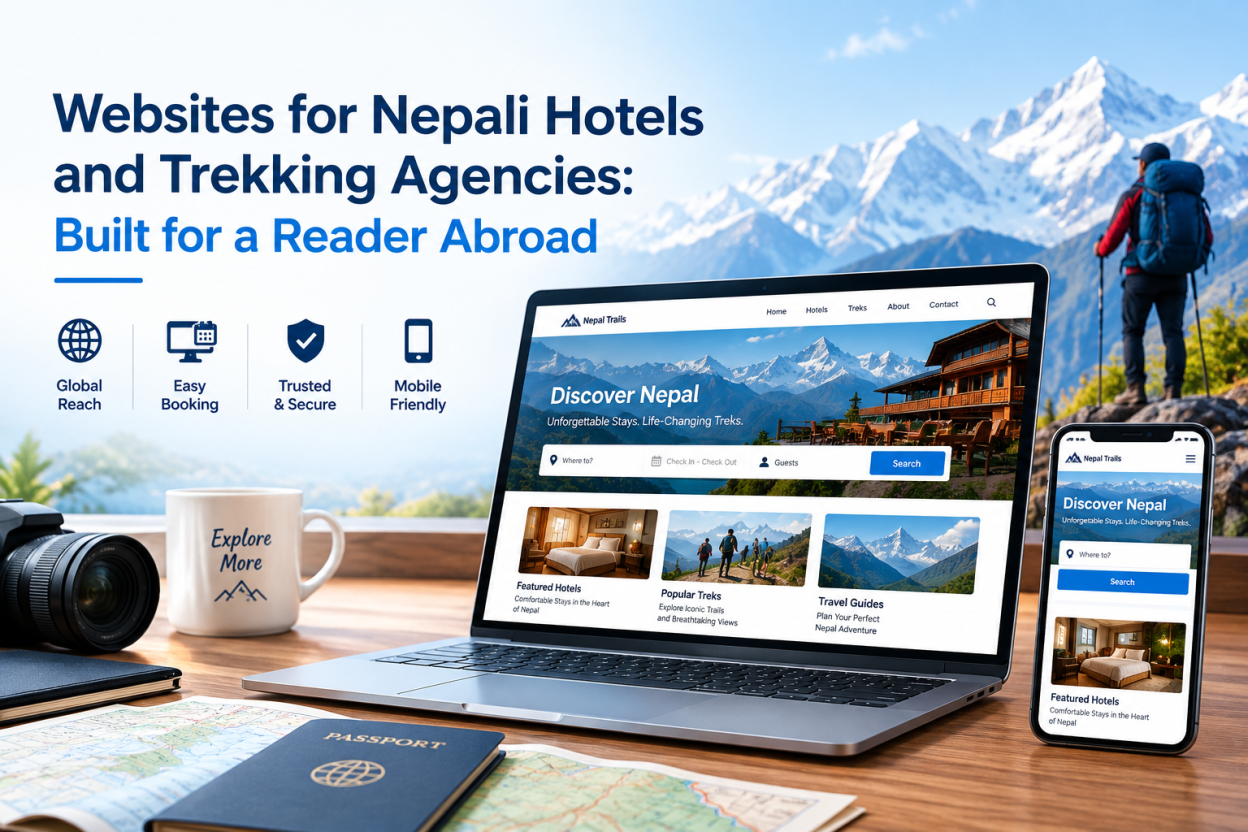
A hotel and trekking website in Nepal is read almost entirely by people who are not in Nepal yet. That single fact changes the language, the trust signals, the payment route and even where the server should sit. Design for a traveller planning from another country, months ahead
Every other kind of Nepali business website serves people inside Nepal. This one does not, and most tourism sites here are built as though it did.
Nepal welcomed 1,158,459 international visitors in 2025, according to Nepal Tourism Board figures released in January 2026. That is 97 percent of the 2019 record of 1,197,191 and a modest rise on the 1,147,548 who came in 2024. Those visitors researched, compared and often paid a deposit before boarding a plane.
So your website is doing its work months before anyone arrives, for someone who has never met you and cannot walk into your office.
Who is actually reading your site
The market mix matters more than most operators build for.
| Source market | Share of 2025 arrivals | What it changes on your site |
| India, 292,438 | 25.2 percent | Short lead times, pilgrimage and short trips, price sensitivity, INR familiarity |
| United States, 112,316 | 9.7 percent | Long planning cycles, high trust bar, detailed itinerary and safety questions |
| China | Roughly 8 percent | Different platform habits, Latin script is a barrier, group travel |
| United Kingdom | Roughly 5 percent | Long-haul planning, insurance and operator credential questions |
| Bangladesh, 57,545 | 5.0 percent | Regional short-haul, similar patterns to Indian visitors |
India alone accounted for 292,438 visitors, a quarter of all arrivals. The top five source countries together made up roughly 53 percent. Regionally, SAARC countries led with 408,103 visitors, followed by Asia excluding SAARC at 253,311, Europe at 221,018 and the Americas at 135,503.
Read that carefully, because it contradicts how most Nepali trekking sites are written. They are built almost exclusively for a Western trekker. Yet the largest single market is India, whose visitors book on shorter notice, travel for pilgrimage as often as trekking, and compare prices differently.
You do not have to serve everyone. But choose deliberately, rather than defaulting to a Western audience because that is what competitors do.
Where the enquiry actually happens
Tourism is an enquiry business, not a checkout business. Very few people book a fourteen-day trek by clicking a button, and building an elaborate booking engine before fixing enquiry handling is a common and expensive mistake.
What converts is a conversation that starts easily and gets answered fast.
- Put WhatsApp on every page. It is how international travellers already message businesses, it works across borders without call charges, and it feels immediate in a way email does not.
- State your response time and then meet it. Someone comparing four operators will often go with whoever replied first and clearly.
- Keep the enquiry form short. Dates, group size, trek or room type, and a message field. Every extra question loses people.
- Show your local time. A traveller in New York needs to know why nobody replied at 3am Kathmandu time. A visible clock or a stated office hours line prevents a lot of assumed rudeness.
This is also where a genuine competitive advantage sits for a small operator. A large agency answers in two days with a template. You can answer in two hours with a real reply. Say so on the site, and then be that.
Should your server be in Nepal?
Honest answer, and it cuts against what a Nepali hosting company would normally tell you: not necessarily, and possibly not.
For a school or a local shop, a server in Nepal means faster pages for Nepali visitors. For a trekking agency, your readers are in Delhi, Chicago, London and Beijing. A server in Kathmandu is the furthest point from most of them.
What actually solves this is a CDN rather than an argument about server location. A content delivery network caches your pages and images at locations near your readers, so a traveller in Texas is served from somewhere close to Texas regardless of where the origin sits. With a CDN in front, the origin location becomes a secondary concern.
The case for hosting locally is then a business one rather than a latency one. You pay in rupees through eSewa or Khalti rather than needing an international card, and support answers during your working day in your language. Those are real advantages, and they are the honest ones. Latency to a traveller in Europe is not.
If the local billing and support matter to you, our website design and development service and hosting are billed in rupees. Put a CDN in front either way.
Taking deposits from abroad is the hard part
This is where tourism businesses hit Nepal’s genuine infrastructure limitation, and no website design solves it.
Nepal is not a supported merchant country for the major global card gateways, so you cannot simply add a card checkout that accepts a Visa payment from a customer in Germany the way an operator in Thailand can. Domestic wallets such as eSewa and Khalti serve Nepali customers well and are of no use to a traveller abroad.
Practical routes that Nepali operators actually use:
- A payment request or link through a service that supports Nepal, sent by email after the enquiry conversation. Since April 2026, Khalti by IME has offered Stripe-powered payment requests for exactly this kind of inbound payment.
- A bank wire for larger bookings, which is normal for group trips and expeditions and rarely surprises a client booking a three-week expedition.
- Taking the balance on arrival in cash or card, with only a modest deposit in advance. Many established agencies work this way.
The full picture on routes, fees and the rules that apply is in our guide to accepting international payments in Nepal.
Whatever you choose, state it plainly on the site. A traveller who cannot work out how to pay you will book with the operator who explained it. Ambiguity about money reads as a warning sign to someone sending several thousand dollars to a country they have never visited.
Trust is the entire product
A traveller is sending money to a stranger in a country they have not visited, to walk in mountains where things occasionally go wrong. Everything on the site is either building that trust or leaking it.
What builds it, roughly in order of weight:
- Named, licensed guides with real photographs. Not stock images of anonymous trekkers.
- Your registration and licence details, stated plainly. Company registration, tourism licensing, and trekking association membership where you hold it.
- Specific safety information. Insurance requirements, acclimatisation schedules, evacuation arrangements and what happens if someone has to turn back. Vague reassurance reads as evasion.
- Real reviews with names and dates, and a link to where they can be verified independently.
- A physical address with a map, and a landline alongside the mobile number.
- Photographs that are visibly yours. Travellers recognise stock mountain photography instantly, and it undermines everything around it.
The single strongest trust asset most Nepali operators already have and rarely publish well is a detailed, honest account of a trip that did not go perfectly. How you handled bad weather, an altitude problem or a cancelled flight tells a prospective client more than any list of five-star reviews.
What an itinerary page actually needs
Itinerary pages are the money pages for a trekking agency, and most are thin where it counts.
Include the daily breakdown with walking hours and altitude gain, not just place names. Include what is and is not in the price, itemised, because that is the question every enquiry asks. Include required permits and who arranges them. Include the fitness expectation honestly, because a client who arrives unprepared is a problem for both of you.
Add the practical detail people search for: best months for that route, typical group size, single supplement, what happens in bad weather, and whether the route suits a first-time trekker.
Two structural points. Give each trek its own page rather than listing twenty routes on one, because someone searching for a specific route should land on a page about that route. And publish prices, or at least a price band. Hiding them means every enquiry starts from zero, and international travellers comparing operators will often skip a site with no pricing at all.
Seasonality changes what your site does
Nepali tourism is sharply seasonal. October 2025 was the peak month with 128,443 arrivals, while December brought 98,190.
Traffic to your site peaks earlier than arrivals do, because people research months ahead. Your busiest enquiry period is not your busiest trekking period, and content published in the quiet season is what ranks by the time the planning season starts.
That gives you a natural working rhythm. Write and update during the monsoon and winter lulls. Fix the site before the planning surge rather than during it. And keep availability information current, because nothing damages a first impression like an enquiry answered with a season that ended two years ago.
Do you still need TripAdvisor and the booking platforms?
Yes, and treating them as competitors to your website is the wrong frame.
Most travellers use both. They discover you on a platform, then visit your site to decide whether you are real. The platform provides reach and reviews. Your site provides depth, personality and a direct booking that does not carry commission.So make the handoff work. Keep your business name, address and phone identical across your site, your Google Business Profile and every platform listing. Link to your independent reviews rather than only quoting them. And give people a reason to book direct, whether that is a better price, a flexible deposit or simply a real conversation before they commit.
Frequently asked questions
Usually not at first. Trekking is an enquiry business, and most clients want a conversation before committing to a two-week trip. Fix enquiry handling, WhatsApp access and response times first. A booking engine makes more sense for a hotel selling rooms than an agency selling itineraries.
Put a CDN in front of it, and the origin location matters far less. Your readers are abroad, so a Nepal-only server is the furthest point from most of them. Hosting locally still has real advantages in rupee billing and same-timezone support, but latency is not one of them for this audience.
Through a payment request or link from a provider that supports Nepal, a bank wire for larger bookings, or a small deposit in advance with the balance on arrival. Nepal is not a supported merchant country for the major global card gateways, so a direct card checkout is not straightforward.
English covers most long-haul markets. Given that India accounted for a quarter of 2025 arrivals, and China for roughly 8 percent, adding content for those audiences
Daily walking hours, altitude gain, an itemised inclusions and exclusions list, permits and who arranges them, an honest fitness expectation, best months, and what happens in bad weather. Give each trek its own page so route-specific searches land on the right one.
During the monsoon and winter lulls. Enquiry traffic peaks months before arrivals do, so work published in the quiet season is what ranks by the time travellers start planning for the October peak.