The digital real estate market is booming. Every day, thousands of new businesses launch, and every single one of them needs a website to establish a digital presence. Consequently, every website needs a reliable web hosting environment to stay online, load quickly, and remain secure. For decades, the web hosting industry has grown steadily, but recently, we’ve seen a massive shift toward specialized solutions like Reseller Hosting, which allows entrepreneurs to offer high-performance hosting tailored to their own clients’ specific business needs.
Table of Contents
1. What Is Reseller Hosting?
2. How Reseller Hosting Works
3. Benefits of Reseller Hosting
4. Reseller Hosting vs Shared Hosting vs VPS
5. Technology Behind Reseller Hosting
6. How to Start a Reseller Hosting Business
7. Future of Reseller Hosting
8. Reseller Hosting FAQs
9. Conclusion
To better understand how reseller hosting works, the diagram below illustrates the reseller hosting business model and how server resources are distributed to client websites.
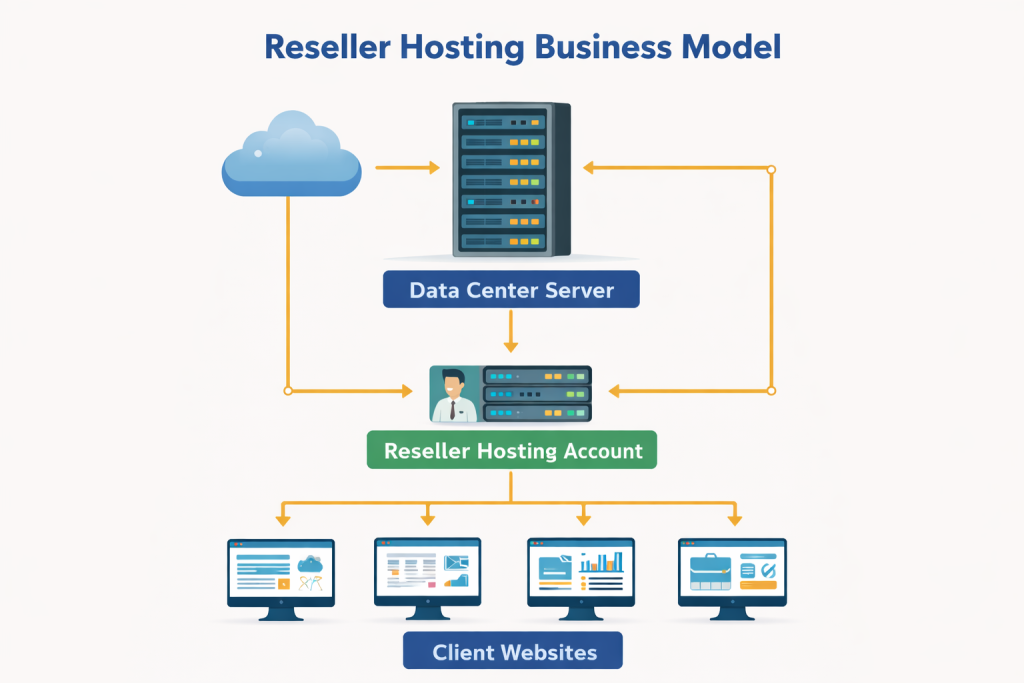
Illustration showing how reseller hosting works by allowing individuals or agencies to purchase server resources and sell hosting services to their own clients.
This market evolution presents a highly lucrative opportunity for entrepreneurs, web designers, and digital marketing agencies: reseller hosting.
Starting your own web hosting business no longer requires millions of dollars in capital, a climate-controlled data center, or a team of hardware engineers working around the clock. Through a reseller hosting business model, you can launch a fully branded web hosting company from your laptop in a matter of days. You can tap into enterprise-grade infrastructure and sell it directly to your clients at a premium.
If you are looking for an authoritative hosting reseller guide, you are in the right place. In this comprehensive pillar article, we will walk you through exactly how reseller hosting works, how to set up your infrastructure, and how to acquire your first clients to start a reseller hosting company that generates predictable, recurring revenue.
What Is Reseller Hosting? (A Real-World Analogy)
The concept of reseller hosting can seem overly technical at first glance, but the easiest way to understand it is to think of it like commercial real estate.
Reseller hosting business model showing how a parent hosting provider supplies server resources that resellers divide and sell to their own clients.
Imagine you want to get into the lucrative apartment rental business. Buying the land, hiring construction crews, and building a massive high-rise apartment building from scratch would cost tens of millions of dollars. It’s an impossible barrier to entry for most people.
Instead of building, you approach the owner of a brand-new, luxury high-rise. You negotiate a deal to lease an entire floor of the building at a massive wholesale discount.
Now, you take that floor, divide it up into ten individual luxury apartments, and rent them out directly to tenants at the standard retail market rate. You act as the landlord. You manage the tenants, collect the monthly rent, and put your own branding on the front door. Meanwhile, the original building owner handles the heavy lifting: fixing the elevators, managing the plumbing, securing the building perimeter, and paying the property taxes.
In the web hosting world:
• The “luxury high-rise” is the physical web server in a data center.
• The “building owner” is the parent hosting provider.
• The “wholesale floor” is your reseller hosting package.
• The “tenants” are your clients’ individual websites.
You handle the client relationships, billing, and basic software support. The parent company handles the data center cooling, network security routing, and hardware maintenance.
Reseller Hosting vs Shared Hosting vs VPS
| Feature | Shared hosting | Reseller hosting | Vps hosting |
| Target Audience | Single website owners, bloggers, small local businesses. | Entrepreneurs, web agencies, developers wanting to sell hosting. | Tech-savvy users,SaaS apps,high-trafficwebsites. |
| Control Panel | Single cPanel account for one user. | Master WHM panelto create multipleindividual cPanel accounts. | Full root access;requires manualserver configuration. |
| Resource Allocation | Resources are shared with hundreds of other random users. | You buy a bulk pool of resources and allocate them to your own clients. | Dedicated virtual resources (CPU, RAM) strictly for your server. |
| White Labeling | No. The provider’s brand is always visible. | Yes. You can completely hide the parent provider and use your own brand. | Yes, but requiresmanual setup of panels andbranding- |
| Profit Potential | None. It is strictly an end-user product. | High. You set your own retail prices and keep the margins. | Medium-High, but requires significantly more technical management to resell. |
| Pricing | Very cheap ($2–$5/month) | Moderate ($20–$50/month) but resellable | Higher ($10–$80+/month depending on resources) |
Understanding these distinctions helps you position your new hosting company effectively in the market and communicate your value to potential clients.
How Reseller Hosting Works
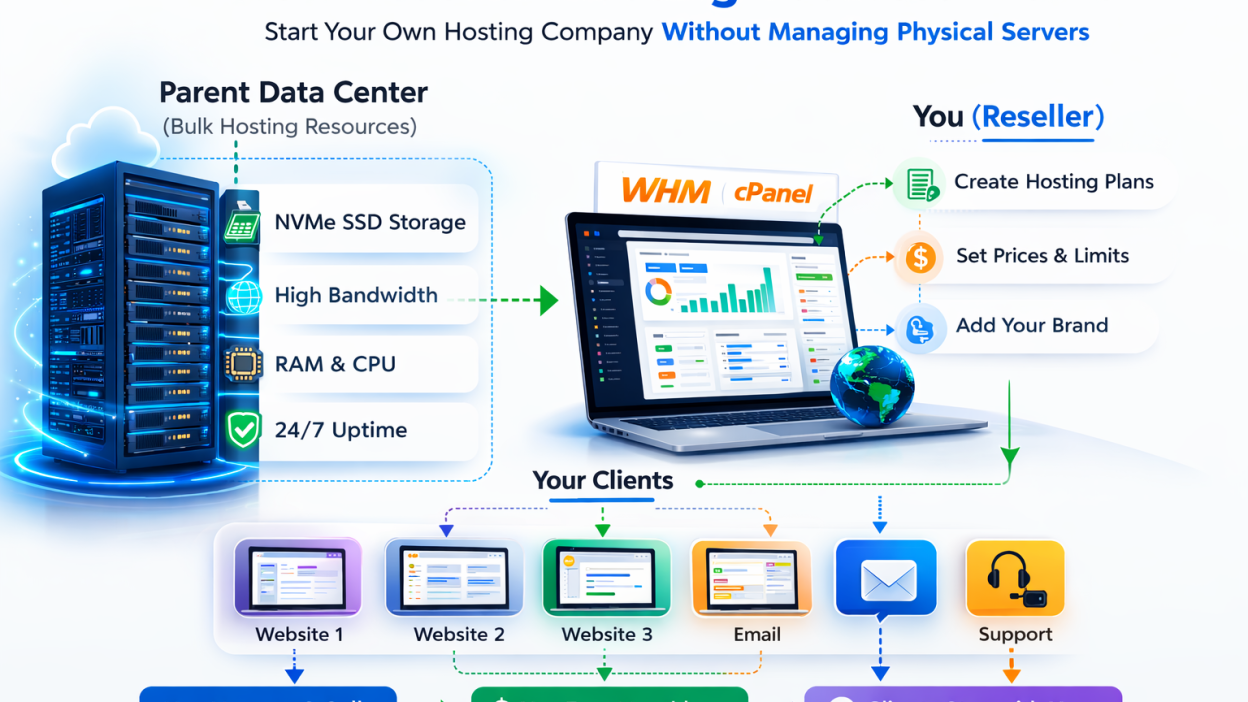
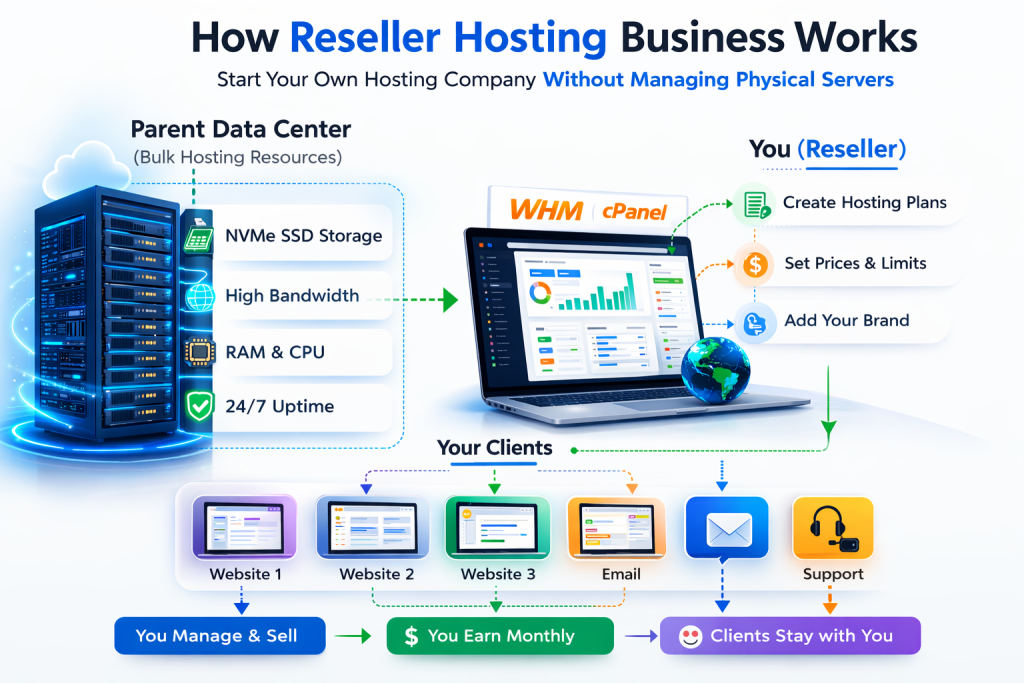
To run a successful reseller hosting business, you need to understand what is happening under the hood. While you don’t need to be a systems administrator, knowing how resources are distributed gives you a massive competitive edge when talking to potential clients.
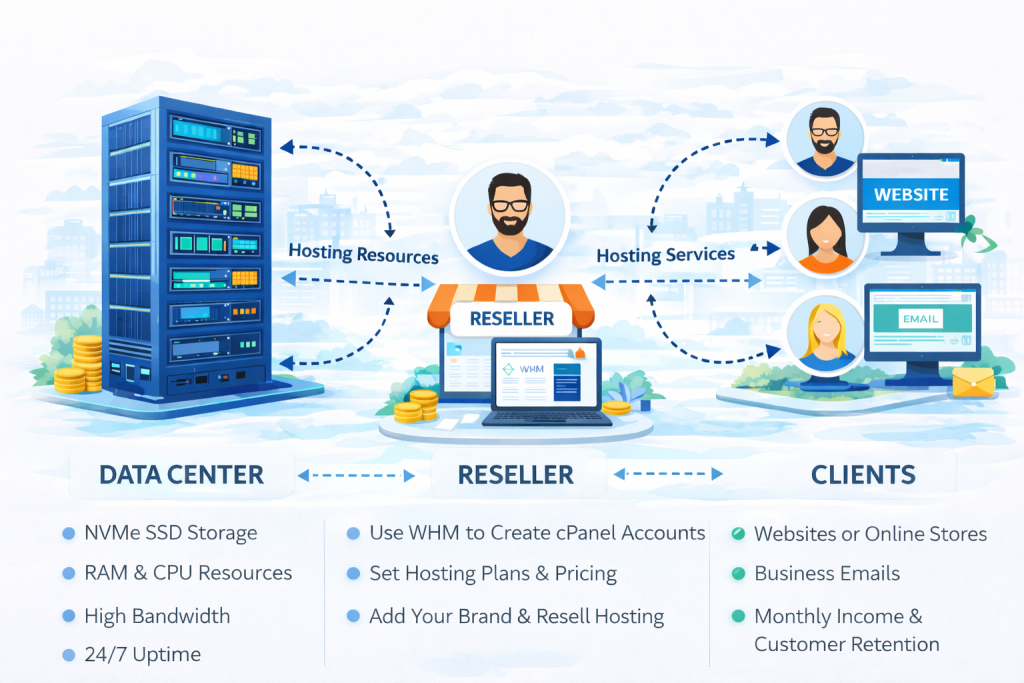
Reseller hosting workflow showing how data center resources are divided and sold to multiple clients.
The Physical Infrastructure
The parent hosting company maintains the physical hardware in highly secure, climate-controlled data centers. Today’s top-tier enterprise infrastructure is incredibly powerful. Instead of standard desktop components, modern hosting environments utilize cutting-edge bare metal.
For example, elite setups often feature 1U rack servers powered by dual AMD EPYC 7763 64-core processors and outfitted with 64GB to 256GB of DDR4 ECC RAM to prevent data corruption.
For storage, standard hard drives are obsolete; the best providers utilize arrays of Gen4 NVMe PCIe SSDs in robust RAID 1 or RAID 10 configurations. This ensures no data is lost during a hardware failure while delivering blindingly fast read/write speeds.
Server Virtualization and IP Routing
Parent hosts often use advanced virtualization environments, like Proxmox, to divide these massive bare-metal servers into secure, isolated containers.
Furthermore, complex network routing sometimes utilizing secure WireGuard tunnels or routing through external VPS nodes is used to manage and distribute dedicated IP addresses safely to the reseller accounts. This ensures your clients have clean, reputable IPs for email deliverability and SEO.
How Resellers Allocate and Sell
When you buy a reseller hosting package, you are essentially buying a designated block of these premium computing resources.
Your plan will dictate your limits, usually defined by:
• Storage Space: The total amount of NVMe disk space you can allocate to your clients (e.g., 100GB total).
• Bandwidth: The amount of data transfer your clients’ websites can use per month.
• Account Limits: The maximum number of individual cPanel accounts you are permitted to create.
Using specialized software, you carve out this bulk resource pool to create custom hosting packages that you sell on your website.
The Technology Behind Reseller Hosting
You might be wondering: If you have to manage dozens or hundreds of clients, won’t that be a technical nightmare?
Not at all.
The entire web hosting industry relies on a stack of standardized, highly intuitive software designed specifically to automate the provisioning and management of accounts.
Here are the core technologies you will use daily to run your reseller hosting business.
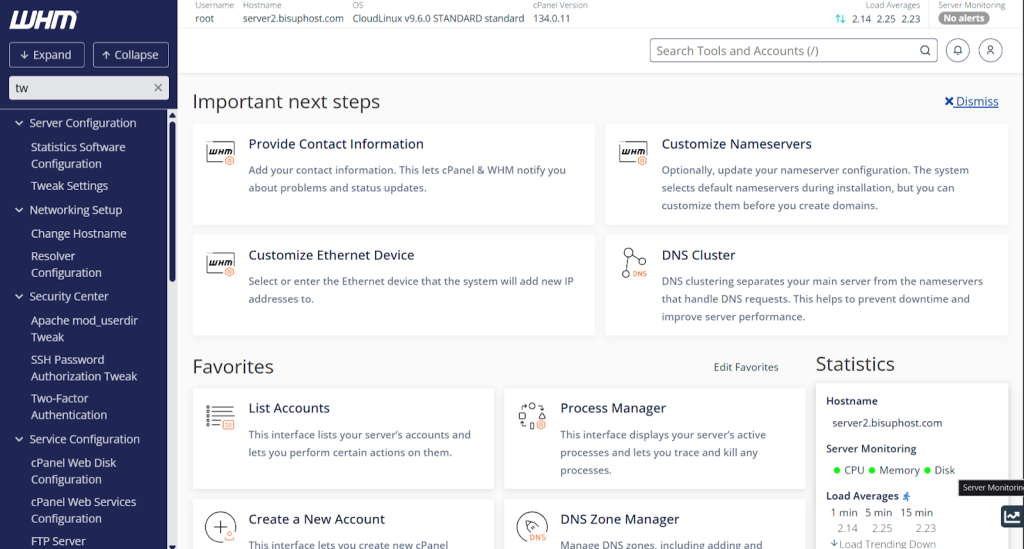
WHM dashboard used in reseller hosting to create cPanel accounts, manage hosting packages, and control server resources.
WHM (Web Host Manager)
WHM is your master control panel. It is the administrative backend where you act as the “server boss.”
Inside WHM, you can:
• Create, suspend, or terminate individual client accounts instantly.
• Build specific hosting packages (e.g., allocating 10GB of disk space and 50GB of bandwidth to a “Pro” plan).
• Monitor server health and resource usage across all your clients to prevent abuse.
• Manage DNS zones, set up custom nameservers, and install SSL certificates.
cPanel
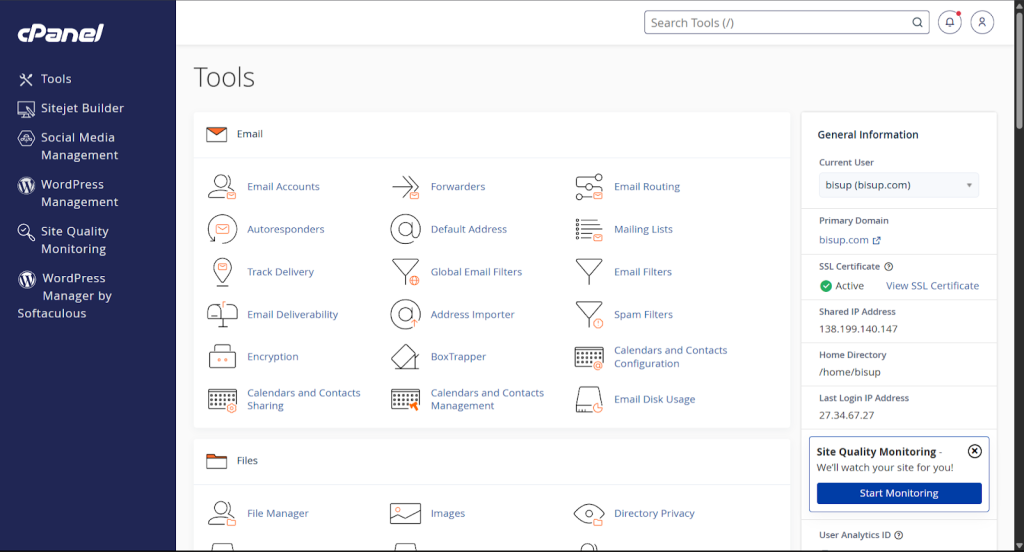
cPanel dashboard used by the client in order to host their site.
While WHM is for you, cPanel is for your clients.
Whenever you create a new client account in WHM, the system automatically generates a unique, isolated cPanel dashboard for that specific user.
From cPanel, they can:
• Install WordPress, Joomla, or Drupal with a single click via automated installers like Softaculous.
• Create professional, branded email addresses (e.g., info@theirbusiness.com).
• Upload and manage website files via a visual File Manager.
• Manage their MySQL databases and configure automated site backups.
WHMCS (Web Host Manager Complete Solution)
If WHM manages the server, WHMCS manages your business.
WHMCS is an all-in-one billing, support, and automation platform for web hosts. It connects directly to your WHM via API.
When a client goes to your website, adds a hosting plan to their cart, and pays via credit card, WHMCS automatically accepts the payment, talks to WHM, creates the cPanel account, and emails the client their login details all completely automatically. It also handles recurring monthly invoices, suspends accounts for non-payment, and provides a built-in ticketing system for customer support.
White Label Hosting Architecture
This is the magic ingredient of a reseller hosting business. “White labeling” means that the parent hosting company remains completely invisible to your end-users. When you utilize a premium platform like BISUP reseller hosting , you can seamlessly white-label every aspect of the client experience.
• You operate under your own domain name.
• You set up custom private nameservers (e.g.,
ns1.yourbrand.com and ns2.yourbrand.com).
• The cPanel dashboards your clients log into feature your company’s logo and color scheme.
As far as your clients are concerned, you own the data center and you are the hosting company. They will never see the name or branding of your upstream provider.
How to Start Your Own Hosting Company: Step-by-Step
Watch Video: How to Start a Reseller Hosting Business (Step-by-Step Guide)
This video from the BISUP team explains how reseller hosting works and how beginners can start their own hosting company.
This reseller hosting tutorial shows how to start a hosting company using WHM and cPanel.
Starting a reseller hosting business is exciting, but it requires a strategic approach. If you rush in without a plan, you will struggle to find clients. Here is the step-by-step blueprint to launch a profitable hosting company.
Step 1: Choose a Specific Niche
The single biggest mistake new resellers make is trying to be the next mass-market giant, offering $2.99/month generic hosting. You cannot win a price war against billion-dollar corporations that spend millions on advertising.
Instead, compete on value, expertise, and specialization. Pick a specific niche.
Examples: Fully managed, high-speed WordPress hosting for local law firms; compliant hosting for healthcare providers; high-performance WooCommerce hosting for boutique e-commerce stores; or specialized hosting for real estate agents.
By niching down, you can charge premium prices ($30 to $150+ per month) because you are providing tailored expertise and a concierge-level service, not just raw server space.
Step 2: Select a Premium Reseller Provider
Your business is only as good as the infrastructure it sits on. You need to partner with a parent host that offers rock-solid reliability, modern server hardware, and excellent support.
Purchase a reseller package that gives you enough room to grow your first 10–20 clients comfortably without immediately hitting resource limits.
Step 3: Create Your Hosting Plans
Log into your WHM dashboard and create your resource packages. Keep the psychology of pricing in mind; offering three distinct tiers is usually optimal:
• Basic/Starter: Perfect for static brochure sites (e.g., 5GB NVMe storage, limited email accounts).
• Professional/Growth: The “sweet spot” tailored for your target niche (e.g., 20GB NVMe storage, daily backups, performance caching).
• Enterprise/Premium: For high-traffic, resource-heavy sites (e.g., 50GB NVMe storage, priority support, dedicated IP).
Step 4: Set Up Billing and Automation
Install WHMCS (or a similar billing platform like Clientexec or Blesta) on your main business website.
Connect it to your preferred payment gateway (like Stripe, PayPal, or Authorize.net). Link WHMCS to your WHM using the provided API keys, and map your newly created packages to your pricing tiers.
Run several test transactions to ensure the automated provisioning, welcome emails, and invoice generation work flawlessly.
Choosing the Best Reseller Hosting Provider
Your upstream provider is your silent business partner. If their servers go down, your clients will be calling you in a panic, and it is your reputation on the line.
Choosing the right provider is the most critical decision in this hosting reseller guide.
Here are the absolute non-negotiables:
Gen4 NVMe Storage
Do not settle for standard SATA HDDs or even older SATA SSDs.
Modern websites, especially heavy WordPress sites, demand extreme database read/write speeds. Look for providers that strictly use Gen4 NVMe storage.
These drives communicate directly with the server’s motherboard via the PCIe interface, offering data transfer rates vastly superior to traditional drives. This translates to lightning-fast website load times for your clients which is a major selling point and a critical factor for Google SEO rankings.
Server Uptime Guarantee and Redundancy
Downtime kills trust instantly. Your provider must offer at least a 99.9% network uptime guarantee, backed by a clear Service Level Agreement (SLA).
Look for data centers that utilize redundant infrastructure such as dual 1400W power supplies per server chassis, massive backup diesel generators, and multiple top-tier fiber optic network carriers to ensure the servers stay online even if a local power grid fails.
Exploring the infrastructure of BISUP reseller hosting will give you a clear baseline of what enterprise-grade redundancy looks like.
Scalability and Resource Limits
As your business grows, you will eventually max out your initial resource block.
You need a provider that allows for seamless, instant scalability. You should be able to upgrade your reseller package to the next tier, or eventually transition your entire WHM setup to a dedicated virtual environment, without having to manually migrate all your clients’ websites and risk data loss.
Support Quality
Even with the best infrastructure in the world, technical glitches happen.
When a complex server issue arises such as a persistent DDoS attack or a massive PHP error that you cannot fix from your WHM you need rapid, 24/7 technical support from your parent provider.
Test their support response times via live chat and ticketing before you commit to purchasing a plan.
Marketing Strategies for Hosting Resellers
You have the infrastructure in place. You have the automated billing system set up.
Now, the most important question: how do you actually get clients when you start a reseller hosting company?
Target Web Design Agencies
Many freelance web designers and creative agencies hate dealing with hosting infrastructure.
They want to design a beautiful site, hand it over to the client, and move on to the next project without worrying about server maintenance or SSL renewals.
Reach out to local designers and offer a strategic partnership.
You provide a reliable, fully managed hosting environment for their clients, and you give the designer a recurring 20% to 30% affiliate commission for every client they send your way.
This creates a powerful, passive referral engine for your business.
Utilizing high-performance infrastructure like BISUP reseller hosting ensures your agency partners will never be embarrassed by slow load times.
Bundle with Web Development Services
If you are a web developer or run an agency yourself, stop telling your clients to “go buy hosting somewhere else and send me the login.”
You are leaving massive amounts of money on the table.
Instead, sell a comprehensive “Website Care Package.”
Combine your reseller hosting with monthly WordPress core updates, daily off-site backups, premium plugin licenses, and security monitoring.
Charge $75 to $200+ per month for this peace of mind.
Clients love having “one dedicated tech person” to handle absolutely everything related to their website.
Focus on Local Startups and Brick-and-Mortar Businesses
Local businesses overwhelmingly prefer working with local experts whom they can trust.
Attend local networking events, Chamber of Commerce meetings, and industry-specific trade shows.
Position yourself as a local web technology partner, not just a faceless hosting vendor.
A local plumbing company, law firm, or restaurant would much rather pay a premium to call you directly than wait on hold with a massive overseas call center when their email goes down.
Common Mistakes Beginners Make
While the reseller hosting business model is highly rewarding, candor requires pointing out the pitfalls.
Avoid these common, yet easily preventable, traps:
Overselling Your Resources
Because not every client uses their maximum allocated storage and bandwidth, WHM allows you to “oversell” meaning you can assign more total disk space to your collective clients than you actually have on the server, betting that they won’t all use it at once.
Do not do this in the beginning.
It is a fast track to resource exhaustion and catastrophic failure.
If one client suddenly gets a massive traffic spike, or a few clients upload massive high-resolution video files, your entire reseller account can hit its physical limits.
This will bring down every single client’s website on your roster simultaneously.
Only allocate the resources you actually possess until you have a deep understanding of your average client’s resource usage patterns.
Providing Bad (or Slow) Support
In the reseller model, you are the face of the company and the first line of defense.
If a client’s email stops working, they contact you.
If you take 48 hours to reply to a support ticket, they will migrate to a competitor.
You must have a professional system in place (like the ticketing portal built into WHMCS) to acknowledge and address client issues promptly.
Even if you have to escalate the issue to your parent host, communicate quickly with your client so they know you are working on it.
Ignoring Security and Backups
Never assume the parent host is taking care of your clients’ specific data security.
While they secure the physical server and the overarching network, you must ensure your clients’ Content Management Systems (like WordPress) are secure.
Set up automated, daily off-site backups via WHM/cPanel.
When a client inevitably installs a malicious plugin or accidentally deletes their homepage, being able to restore their site in one click will make you look like a hero and guarantee their loyalty for years.
Future of Reseller Hosting
The hosting industry does not sit still. It evolves rapidly alongside internet technology. To future-proof your new hosting company, you must stay ahead of the curve and anticipate where the industry is moving.
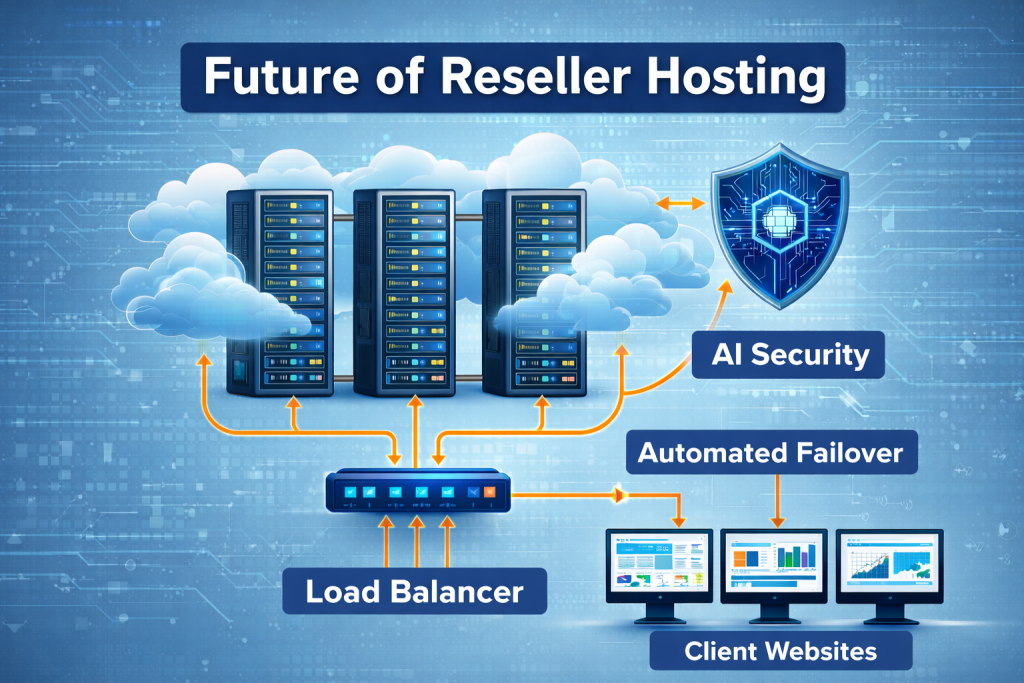
Modern cloud reseller hosting infrastructure with AI security, automated failover, and load balancing for high availability
Cloud Hosting Integration
Traditional shared reseller hosting binds your account to a single physical server. The future is transitioning toward Cloud Reseller Hosting. Cloud infrastructure distributes server resources across a massive, interconnected cluster of servers. If one piece of hardware fails, the virtual environment instantly shifts to another node without any downtime. This offers incredible redundancy and allows for instant, elastic scaling. Many top-tier providers are modernizing their reseller platforms to be entirely cloud-native.
The Rise of Automation and AI
Automation and Artificial Intelligence are taking over the mundane, repetitive tasks of server management. We are seeing the integration of AI-driven security firewalls that can predict, identify, and block zero-day malware attacks before they even execute on the server. Additionally, predictive auto-scaling features will soon allow reseller environments to dynamically allocate RAM and CPU to specific client sites anticipating traffic spikes, ensuring flawless performance without manual intervention.
Business Growth into Managed Services
Selling raw server space by the gigabyte is becoming a race to the bottom. The real financial growth in the reseller hosting business lies in managed services. Future successful resellers will act as holistic digital growth partners offering built-in SEO auditing tools, integrated cloud email suites (like Google Workspace or Microsoft 365), automated performance optimization, and advanced security monitoring right from the client dashboard.
Frequently Asked Questions About Reseller Hosting
To ensure you have all the information you need before you start a reseller hosting company, here are answers to the most common questions entrepreneurs ask.
Is reseller hosting profitable?
Yes, it can be incredibly profitable, largely because it relies on a recurring revenue model. Since your overhead costs are fixed (you pay a flat monthly wholesale fee for your reseller package), every new client you add increases your overall profit margin. For example, if you pay $40/month for a premium reseller account and host 20 clients paying you $30/month for managed hosting, you are generating $600 in monthly recurring revenue with excellent margins.
Do you need technical skills for reseller hosting?
You do not need to be a software engineer or a Linux systems administrator to run a successful reseller business. The control panels (WHM and cPanel) are graphical, highly intuitive, and designed for ease of use. If you know how to navigate basic web applications, configure settings, and read documentation, you can easily manage a reseller account. However, acquiring a basic understanding of how domain names, DNS records, and Content Management Systems (like WordPress) function is highly recommended so you can effectively troubleshoot for your clients.
How many websites can reseller hosting support?
This entirely depends on two critical factors: the resource limits of the reseller package you purchased, and the size, optimization, and traffic volume of the websites you are hosting. A standard mid-tier reseller account equipped with 100GB of NVMe storage could comfortably host 30 to 50 standard small business brochure websites. Conversely, if you are hosting massive, unoptimized e-commerce stores with heavy daily traffic, that same account might only safely support 5 to 10 websites before you need to upgrade your tier.
Is reseller hosting good for agencies?
Absolutely. Reseller hosting is arguably the best passive income strategy for web design and digital marketing agencies. Instead of designing a website and sending the client away to purchase their own hosting, an agency can offer a “fully managed” experience. This allows the agency to control the server environment (ensuring the site runs fast and securely), charge a monthly retainer for hosting and maintenance, and turn a one-off web design project into a long-term, revenue-generating relationship.
Conclusion
Starting your own web hosting company might sound like a daunting, hardware-intensive challenge, but a reseller hosting model beautifully simplifies the entire process. By leveraging the enterprise-grade hardware of established data centers, utilizing industry-standard automation tools like WHM and WHMCS, and applying a smart white-label marketing strategy, you can build a highly profitable digital business from anywhere in the world.
Remember the golden rules of this industry: do not compete on price with massive corporate giants, pick a highly specialized niche where you can add real value, partner with an upstream provider that offers genuine Gen4 NVMe performance and robust redundancy, and above all, prioritize exceptional, personalized customer support.
The internet isn’t shrinking. The demand for fast, reliable, and expertly managed web hosting is only going to grow as more brick-and-mortar businesses and startups move online. Whether you are looking to create a passive side income stream or build a full-scale digital agency, reseller hosting remains one of the most accessible, scalable, and sustainable business models available today.
Take the time to set up your infrastructure correctly, automate your billing, and clearly define your target audience, and you will be well on your way to becoming a trusted, highly sought-after hosting provider.
Ready to launch your own hosting business? Explore BISUP’s premium Gen4 NVMe Reseller packages today and get started in minutes.