
Almost nobody selling you a domain explains what sits underneath the price, so comparing offers in Nepal feels like guesswork. It is not. The underlying cost is published, and once you know it, the differences between registrars become easy to read.
We are one of the companies in this comparison, which is a reason to be sceptical of it. So the approach here is to state where our figures come from, to say plainly where we are not the right answer, and to give you the checks that let you verify any of it yourself.
Entry prices are close enough to ignore
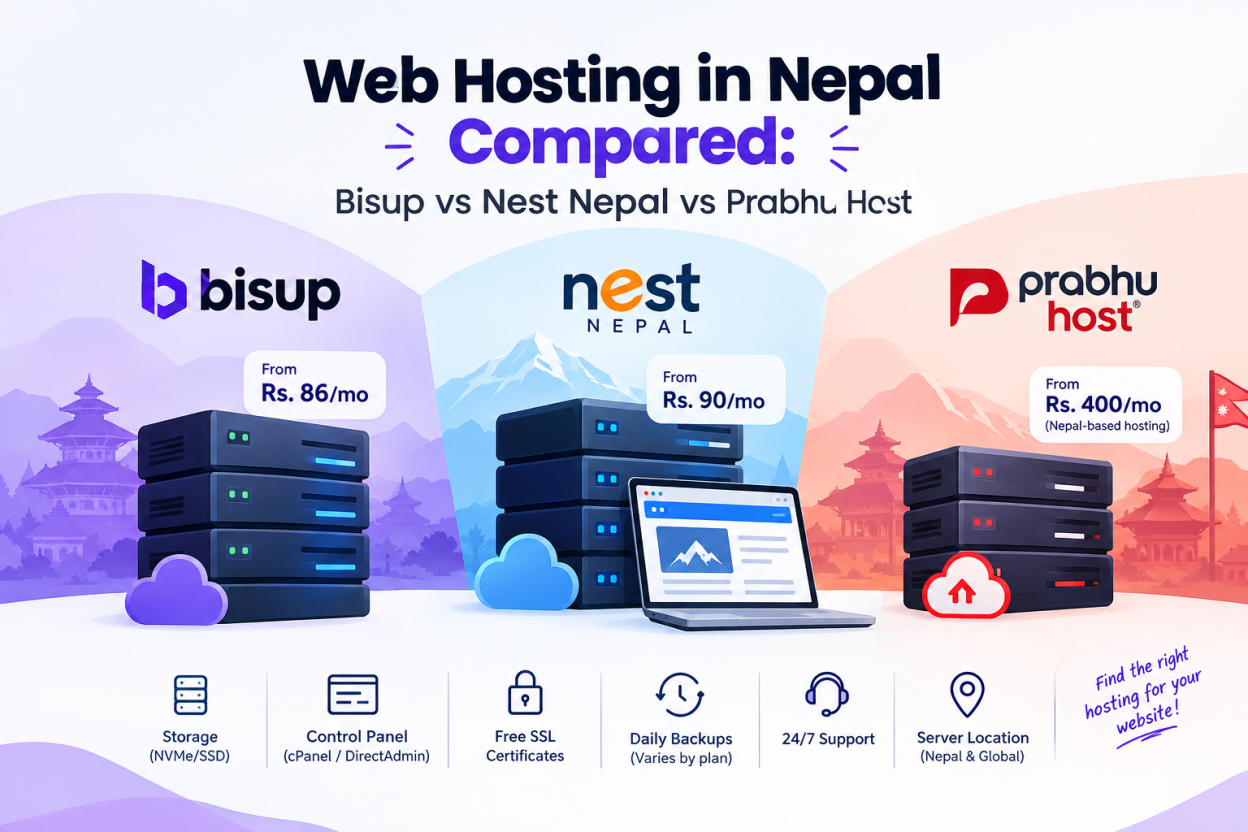
Read from each provider’s own pages on 5 September 2026: our shared hosting starts at Rs. 86 per month, and Nest Nepal’s shared hosting starts at Rs 90 per month. On the Prabhu Host pages we checked, monthly shared pricing was not clearly listed in a comparable form, so we are not quoting a figure rather than guessing at one.
| Bisup | Nest Nepal | Prabhu Host | |
| Shared entry price | Rs. 86 per month | Rs. 90 per month | Not clearly listed on the pages we checked |
| Billing currency | NPR | NPR | NPR |
| Local payment | eSewa and Khalti | Local methods | Local methods |
| Free .com.np help | Yes, with a cover letter generator | Yes | Yes, with a cover letter generator |
| Where to verify | Provider’s own pricing page | Provider’s own pricing page | Provider’s own pricing page |
A four rupee monthly difference is not a business decision. Over a year that is roughly the price of a cup of tea, and anyone choosing a host on that basis is optimising the wrong variable.
Two cautions on any price comparison, including this one. Promotions run frequently, so the figure you see may be introductory rather than steady-state. And entry plans differ in what they include, so compare the plan you would actually buy rather than the cheapest row on each page.
What actually drives hosting cost, and the tiers worth paying for, is covered in our guide to web hosting cost in Nepal.
What the marketing language hides
The claims on Nepali hosting pages, ours included, are broadly similar. Here is how to read them.
- Unlimited storage or bandwidth is never unlimited. It means no stated number, governed by an acceptable use policy. Ask what happens when you exceed normal usage, and whether you are throttled, charged or contacted.
- Uptime percentages are only meaningful with a remedy attached. Ask what happens if the figure is missed, and whether anyone measures it other than the provider.
- Free migration usually has limits on the number of sites or their size. Ask for the limit in writing.
- Free SSL almost always means an automated certificate, which is genuinely fine for most sites. It is not a premium product, so treat it as table stakes rather than a differentiator.
- Free domain offers frequently exclude renewal. Check the second-year price before treating it as a saving.
None of this is unique to Nepal, and none of it is dishonest by itself. But a provider willing to give you specific numbers when asked is telling you something useful about how they will behave when you have a problem.
Does a local host actually perform better?
For a Nepali audience, generally yes, and the reason is physical rather than promotional.
A server closer to your visitors means a shorter round trip for every request, which shows up most on the pages that cannot be cached, such as a checkout or a logged-in dashboard. For a site whose readers are in Nepal, that is a real and repeatable advantage.
The honest limit is that it stops mattering, and can reverse, when your audience is elsewhere. A trekking agency selling to visitors in Europe and North America, or an IT firm serving clients abroad, is better served by a content delivery network in front of the site than by arguing about where the origin server sits. In that case a Nepali host is chosen for billing and support convenience, not for speed.
Be sceptical of performance claims from any provider, including ours, that are not accompanied by a stated measurement method and date. A screenshot of a fast result proves that one test, on one day, from one place.
Where each provider tends to be strongest
Based on what each publishes and on how they position themselves, rather than on private benchmarks we cannot show you.
Nest Nepal competes closely on entry price and has a broad shared hosting range, so it is a natural direct comparison at the budget end.
Prabhu Host is well established in the Nepali market, and like us it offers help with the free .com.np route including a cover letter generator, which matters for businesses starting from nothing.
We compete on local payment through eSewa and Khalti, NVMe storage on shared plans, included SSL, and support in Nepali working hours. Our own comparison table on the hosting page also claims transparent renewal pricing, which is a claim you should hold us to by asking for the renewal figure before you buy.
What none of us can fairly claim is a decisive technical advantage at the shared hosting tier. At Rs. 86 to Rs. 90 a month you are buying a slice of a shared server from a small local company. The differences that will actually affect you are how quickly someone answers when the site breaks, and how straight they are with you about limits.
Where a Nepali host is the wrong choice
Four situations where we would tell you to look elsewhere, because pretending otherwise wastes your money and our support time.
- Your audience is mostly outside Nepal and you are not willing to run a CDN. A host closer to your readers will serve them better.
- You need a specific managed platform or a service tier that small local providers do not operate. Buying a general shared plan and hoping is a false economy.
- You require formal contractual guarantees with financial remedies. Ask for the written terms; if they do not exist, factor that in.
- You are running something genuinely resource-heavy, such as video, on a shared plan. That belongs on a VPS or dedicated resources regardless of provider, and no shared plan from anyone will hold it.
Equally, a local host is a straightforwardly good fit if your customers are in Nepal, you want to pay in rupees without an international card, and you want to raise a support ticket in your own timezone and language.
How should you actually choose?
Ignore the marketing and ask five questions. The answers, and how readily they are given, will tell you more than any comparison article.
- What is the renewal price, not the first-year price? Ask for it in writing before you buy.
- What happens when I exceed the resources on this plan: am I throttled, charged, or contacted?
- How do I get my data out if I leave, and is there a fee for that?
- What are your actual support hours, and what is a realistic first response time for a site that is down?
- Where is the server, and can I have a test address to measure it myself before I commit?
That last question is the most revealing. A provider comfortable with you measuring their server before you pay is confident in it. If the answer is evasive, that is your answer.
If our answers suit you, our cheap web hosting in Nepal plans start at Rs. 86 per month with local billing. If they do not, one of the others in this comparison may fit you better, and that is a fine outcome.
Should you migrate an existing site?
Only for a reason you can name. Migration carries risk, and moving to save four rupees a month is not worth it.
Good reasons to move: your current host is slow for the audience you actually have, support does not respond when the site is down, you are paying in a currency that makes renewal difficult, or you have outgrown the plan and your provider has nothing sensible to move up to.
Poor reasons: a marginally cheaper headline price, or a promotional first year that will renew higher than what you pay now.
If you do move, the sequence matters more than the destination. Our guide to migrating to a Nepali host covers testing before the switch, and pointing your domain at the new host covers the step where email most often breaks.
Frequently asked questions
There is no single answer, and any provider claiming to be it, including us, is selling rather than advising. Entry prices sit within a few rupees of each other, so choose on support responsiveness, honesty about limits, and whether the server location matches where your visitors are.
Entry-level shared hosting sits at roughly Rs. 86 to Rs. 90 per month among the providers we checked on 5 September 2026. Compare the plan you would actually buy rather than the cheapest row, and always ask for the renewal price.
For visitors inside Nepal, usually yes, because the server is physically closer and every request has a shorter round trip. For visitors abroad, the advantage disappears and a content delivery network matters more than where the origin server sits.
No. It means there is no stated number, governed by an acceptable use policy. Ask what happens when you exceed normal usage, and whether you are throttled, charged or contacted. A provider that answers specifically is worth more than one that repeats the word unlimited.
Rarely. Migration carries risk and the price differences between Nepali providers are small. Switch when your current host is slow for your actual audience, when support does not respond during an outage, or when billing currency makes renewal unreliable.
Yes. The main Nepali providers bill in rupees and accept local payment methods, and we accept eSewa and Khalti. This matters more than it sounds, because a renewal that fails on a declined card does not announce itself until the site goes down.


