Best Reseller Hosting Guide: How to Build Your Own Hosting Company

Best Reseller Hosting Guide: How to Build Your Own Hosting CompanyHave you ever wondered how thousands of web design agencies, IT consultants, and entrepreneurs manage to offer reliable web hosting to their clients without owning massive, multi-million-dollar data centers? The secret is something called reseller hosting.If you are looking to build recurring revenue, scale a digital agency, or launch the next big hosting brand from your home office, you are in the right place. The web hosting industry is booming, and small businesses are increasingly abandoning giant, faceless hosting corporations in favor of localized, niche, and highly supportive independent hosts.This comprehensive, step-by-step guide will walk you through exactly how to build your own hosting company from the ground up in 2026. We will cover the technology, the business strategy, the marketing tactics, and the future trends you need to know to stay ahead.Grab a cup of coffee. We’re about to build your hosting empire.1. What is Reseller Hosting?At its core, reseller hosting is a white-label business model where you rent server space and resources from a larger, established web hosting provider, and then divide those resources to sell them to your own clients under your own brand name.Think of it like commercial real estate. A property management company buys a massive skyscraper. Instead of using the whole building, they lease out individual floors or offices to different businesses. In the reseller hosting world, the primary hosting company owns the “skyscraper” (the enterprise-grade servers), and you are renting a large block of space at wholesale prices. You then become the landlord, subleasing “offices” (hosting accounts) to your retail customers.The beauty of this model is that the primary host handles all the heavy lifting. They manage the physical hardware, power redundancies, network connections, cooling systems, and physical server security. You focus entirely on sales, marketing, and front-line customer support. Your clients will never know that the underlying infrastructure belongs to someone else—to them, you are the hosting company.2. How Reseller Hosting WorksTo truly succeed, you need to understand the mechanics of the service you are selling. When you sign up for a reseller package, you are typically given a specific allocation of resources. This usually includes: * Disk Space: The amount of storage you can allocate across all your clients (e.g., 100 GB of NVMe storage). * Bandwidth: The amount of data transfer allowed per month. * cPanel/Account Limits: The maximum number of individual client accounts you can create.Once you have these bulk resources, you step into the role of the architect. You log into your master control panel and create customized hosting plans.For example, you might create a “Basic Starter Plan” that includes 5 GB of storage and 50 GB of bandwidth, and a “Pro E-commerce Plan” that includes 20 GB of storage and unmetered bandwidth. When a client buys a plan from your website, their individual account is provisioned, giving them access to their own isolated dashboard to manage their website, emails, and databases.You charge your clients a retail price (say, $15 to $50 a month), pay your provider the wholesale price, and keep the margin. Because web hosting is a subscription service, this creates a highly lucrative stream of recurring revenue.3. The Holy Trinity of Hosting Tools: WHM, cPanel, and WHMCSYou cannot run a modern hosting company with a spreadsheet and a PayPal link. To automate your business and provide a professional experience, you will rely on an integrated software stack. The industry standard consists of three main tools.Web Host Manager (WHM)WHM is your administrative dashboard. It is the backend control center where you manage your entire hosting ecosystem. Through WHM, you can: * Create, suspend, or terminate client accounts. * Define the resource limits for your custom hosting packages (disk space, bandwidth, email accounts). * Monitor server status and resource usage. * Configure DNS zones and manage SSL certificates globally.cPanelWhile WHM is for you, cPanel is for your customers. When a client purchases hosting from you, they receive a login to their own isolated cPanel environment.This graphical interface allows them to easily manage their specific slice of the server without needing to know any code. They can install WordPress with one click, create custom email addresses (like info@theirbusiness.com), manage their files, and backup their data. cPanel is heavily white-labeled, meaning you can put your own company logo at the top of their dashboard.WHMCS (Web Host Manager Complete Solution)If WHM is the engine, WHMCS is the brain of your business. WHMCS is an all-in-one client management, billing, and support platform. It completely automates the hosting lifecycle.Here is how WHMCS transforms your business into an automated machine: * Automated Provisioning: A client visits your website at 3:00 AM, selects a hosting plan, and pays via credit card. WHMCS verifies the payment, talks to WHM, creates the cPanel account, and emails the client their welcome details—all while you are sleeping. * Recurring Billing: WHMCS automatically generates invoices, charges credit cards on file, and sends payment reminders. If a client fails to pay, WHMCS can automatically suspend their account after a set number of days. * Ticketing System: It includes a robust support desk where clients can open tickets if they need help, allowing you to manage customer service efficiently.4. Step-by-Step Guide to Starting a Reseller Hosting BusinessBuilding a hosting company requires a strategic approach. Follow these steps to lay a rock-solid foundation.Step 1: Identify Your NicheDo not try to be the cheapest host on the internet. You will lose to mega-corporations with bottomless marketing budgets. Instead, be the best host for a specific group of people.Profitable niches include: * WordPress for Local Businesses: Target plumbers, lawyers, and dentists in your specific city or state. * High-Performance E-commerce: Build plans optimized specifically for WooCommerce or Magento stores that require blazing-fast loading speeds. * Agency Hosting: If you are a web designer, bundle hosting into your monthly website maintenance packages. Your clients pay one fee for design, updates, and hosting.Step 2: Choose Your Reseller ProviderYour reputation hinges on the hardware and network of your upstream provider. You need a partner that offers impeccable uptime, rapid support, and modern infrastructure.For an excellent example of what a robust, performance-driven provider looks like, check out BISUP. Providers like BISUP allow you to leverage premium infrastructure, meaning you can sell top-tier speeds to your clients without worrying about server maintenance.Step 3: Configure Your Software StackOnce you purchase your reseller account, the first technical step is integration. * Install WHMCS on a dedicated billing domain (e.g., clients.yourhosting.com). *

Connect WHMCS to your WHM via API keys so the two systems can communicate. * Set up your payment gateways (Stripe, PayPal, etc.) inside WHMCS. * Brand your cPanel interface with your logo and company colors.Step 4: Design Your Hosting PackagesIn WHM, create 3 to 4 tiered packages. Keep it simple. Too many options overwhelm buyers. * Starter: Good for personal blogs and simple landing pages. * Professional: Higher storage and RAM, ideal for standard small business websites. * Business/Premium: Maximum resources, prioritized support, daily backups, geared toward high-traffic e-commerce sites.Step 5: Build Your Hosting WebsiteYour storefront needs to look professional, secure, and trustworthy. Use a clean, modern design. Clearly outline the benefits of your packages, highlight your customer support, and ensure your WHMCS shopping cart is seamlessly integrated into the site design.5. How to Choose the Best Reseller Hosting

ProviderChoosing your underlying provider is the most critical decision you will make. If their servers go down, your clients call you in a panic. Here is exactly what to look for when evaluating a master host:True White-Label CapabilitiesYour provider should be completely invisible to your customers. Ensure they offer custom name servers (e.g., ns1.yourdomain.com), anonymous server hostnames, and fully brandable control panels.Cutting-Edge Hardware InfrastructureIn 2026, standard hard drives (HDDs) and even older SATA SSDs are obsolete for serious web hosting. You need a provider that utilizes next-generation hardware to guarantee speed.Look for hosts that deploy server architectures similar to a Dell PowerEdge R6525. The gold standard involves Dual AMD EPYC processors (like the 64-core 7763), which provide unparalleled multi-threading capabilities, ensuring that traffic spikes on one client’s site don’t lag the whole server. Furthermore, ensure the provider utilizes Gen4 NVMe PCIe SSDs. NVMe drives are exponentially faster than standard SSDs, directly resulting in faster database queries and better SEO rankings for your clients’ websites. DDR4 PC4-3200AA ECC RAM is also a must for error correction and stability.24/7/365 White-Glove SupportAs a reseller, you handle tier 1 support (basic client questions). But if a server kernel panics or a node goes offline, you need to rely on your provider’s tier 2 and tier 3 support. Test their live chat and ticketing response times before signing up. If they take 12 hours to respond to a pre-sales question, imagine how long they will take during an outage.Strict Security and IsolationLook for providers using CloudLinux. CloudLinux encapsulates each cPanel account in its own isolated virtual environment (CageFS). If one of your clients installs a vulnerable WordPress plugin and gets hacked, CageFS prevents the malware from spreading to your other clients’ accounts.6. Pricing and Marketing StrategiesNow that your infrastructure is ready, you need customers. Hosting is highly competitive, so your marketing strategy must be precise.Value-Based Pricing (The Margin Secret)Never compete on price. If you charge $2 a month, you will attract the most demanding, highest-churn clients. Instead, compete on value.If your raw cost per account is $1.50/month, do not sell it for $5. Sell a “Worry-Free Managed Web Plan” for $49/month. Bundle the hosting with added value: * A free SSL certificate. * Automated daily backups. * One free site migration. * A 30-minute monthly “tech consultation” (which clients rarely use, but love having).By doing this, your profit margins shift from pennies to dollars, and you attract serious business owners who value uptime over a bargain.Local SEO DominanceOptimize your website to capture local search traffic. Instead of trying to rank for “buy web hosting,” aim for “managed web hosting for restaurants in [Your City].” Create content highlighting how local server speeds benefit local search rankings.The B2B Partnership PipelineReach out to freelance web developers and marketing agencies in your network. Offer them a lucrative affiliate commission or a discounted bulk rate if they migrate their clients to your servers. Developers hate managing servers; if you can take that headache away from them while providing a kickback, you will secure clients by the dozens.7. Common Mistakes Beginners MakeAvoid these pitfalls that crush new hosting companies in their first year: * Overselling Resources: It is tempting to put 500 clients on a small reseller plan, assuming they won’t use their full bandwidth limits. When traffic spikes, the server crashes, and you lose your reputation. Grow your capacity responsibly. * Ignoring Backups: Hardware fails. Ransomware happens. Always ensure you have a remote, automated backup solution configured for your clients. Do not rely solely on the underlying provider’s backups. * Lacking a Service Level Agreement (SLA): Be clear about what you support and what you don’t. If a client’s custom PHP script breaks because they wrote bad code, that is a developer issue, not a hosting server issue. Set boundaries to protect your time. * Poor Onboarding: If a client buys a package and receives a confusing, highly technical email, they will cancel. Spend time designing beautiful, easy-to-understand welcome emails explaining exactly how they can upload their site or point their domain.8. The Future of Reseller HostingAs we move deeper into the late 2020s, the reseller hosting landscape is undergoing a massive shift. To stay relevant, you need to look ahead.AI and AutomationArtificial Intelligence is revolutionizing customer support. Forward-thinking resellers are integrating AI chatbots trained on their internal knowledge bases. These bots can instantly resolve common tier-1 issues—like password resets, DNS propagation checks, or email client configurations—allowing you to offer 24/7 support without hiring a massive nighttime staff.Advanced Cloud-Native ScalingEventually, highly successful resellers outgrow standard master-provider plans. The future for these scaling businesses involves hybrid cloud setups and advanced virtualization.For instance, top-tier independent hosts are adopting hypervisors like Proxmox to manage their own dedicated bare-metal servers. They are using advanced networking techniques—such as establishing secure WireGuard tunnels between a local high-performance server and cloud endpoints like a Hetzner VPS—to seamlessly route IP addresses, mitigate DDoS attacks, and balance loads. This level of architectural control allows a growing reseller to transition into a true enterprise infrastructure provider.Green Hosting and SustainabilityData centers consume massive amounts of electricity. Eco-conscious hosting is becoming a major selling point. In the near future, clients will actively seek out hosts that utilize servers powered by renewable energy, or providers that invest in carbon offset programs. Marketing your reseller brand as a “Green Host” can tap into this rapidly growing consumer demand.Conclusion: Start Your Hosting Journey TodayBuilding your own hosting company through the reseller model is one of the most accessible and scalable digital businesses you can start today. It requires very little upfront capital, minimizes your technical risk, and offers the holy grail of business: predictable, recurring revenue.By understanding the technology stack (WHM/WHMCS), choosing high-performance underlying infrastructure, finding a specific niche, and providing stellar human support, you can carve out a highly profitable slice of the internet.The web is only getting bigger, and every new website needs a home. Why shouldn’t that home be with you? Take the leap, configure your first package, and start building your hosting empire today.

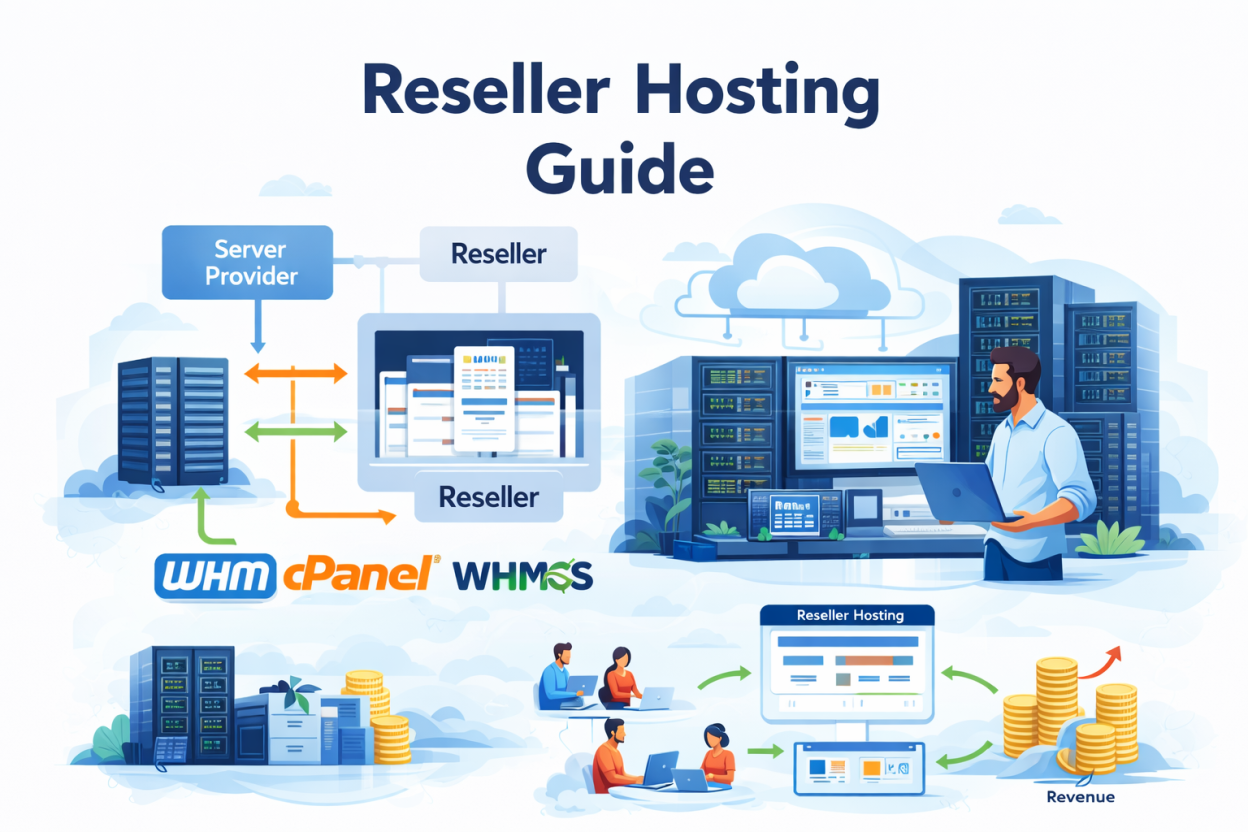
Reseller hosting infographic explaining how to start a reseller hosting business using WHM, cPanel and WHMCS

Previous Article

WHM Reseller Hosting: How to Launch and Manage Your Own Hosting Business in Nepal

Next Article

Best VPS Hosting in Nepal (2026 Guide)

Write a Comment

Leave a Comment

Your email address will not be published. Required fields are marked *

Subscribe to our Newsletter

Subscribe to our email newsletter to get the latest posts delivered right to your email.
Pure inspiration, zero spam ✨