
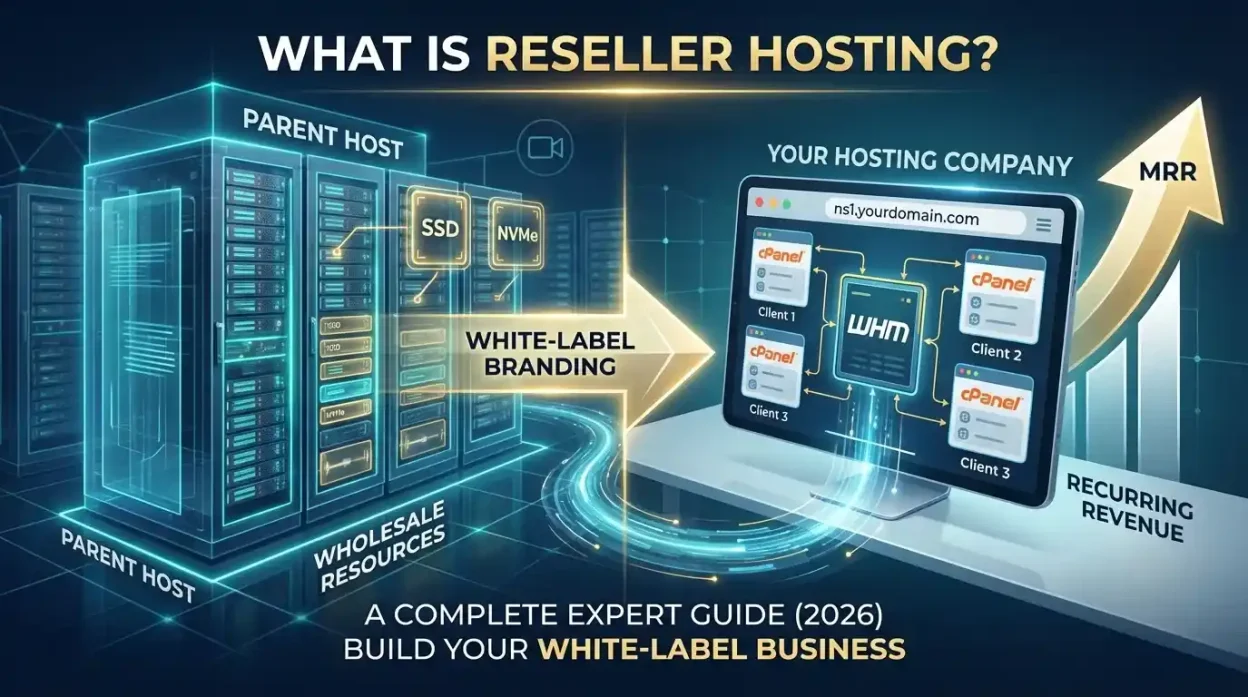
Have you ever wondered how thousands of web designers, freelancers, and small agencies offer hosting to their clients without owning a single server? The answer is reseller hosting, and it might be the easiest online business you can start this year.
So, what is reseller hosting exactly? Reseller hosting is a business model where you buy server resources in bulk from a hosting provider, then divide and sell those resources to your own clients under your own brand name. You never touch the physical hardware. Your provider handles the data center, the network, and the security, while you focus on clients, pricing, and support.
This guide walks you through how reseller hosting works, who it is best suited for, the real economics behind it, and the exact steps to launch your own hosting company.
A Quick Glossary of Reseller Hosting Terms
Before going further, it helps to understand a few terms that come up constantly in this industry.
- Parent host: The wholesale provider (like Bisup) that owns and maintains the physical servers.
- WHM (Web Host Manager): The master dashboard you use to create client accounts and allocate resources.
- cPanel: The individual control panel your clients use to manage their own website, email, and files.
- WHMCS: Billing automation software that handles signups, invoices, and account suspensions for you.
- White-label branding: The setup that hides your parent host’s name and replaces it with your own, using custom nameservers such as ns1.yourbrand.com.
- CloudLinux and inodes: Server technology that isolates each client account, so one problematic site cannot crash the whole server.
What Is Reseller Hosting? A Simple Analogy
Picture commercial real estate. Building an entire office tower from scratch would cost millions of dollars, and that is out of reach for most entrepreneurs.
Instead, you lease an entire floor of an existing tower at a wholesale rate. You then divide that floor into smaller offices and rent them out individually at full market price. You collect the rent, you put your name on the door, and you deal directly with your tenants. Meanwhile, the building owner still handles the elevators, the security, and the plumbing.

Reseller hosting works exactly the same way. The “building” is a physical server sitting in a data center. The “building owner” is your parent hosting provider. Your reseller package is the “floor” you lease at wholesale pricing, and your clients’ websites are the “tenants.” You manage billing, branding, and basic support. Your provider manages the hardware, the network, and the uptime.
How Reseller Hosting Works, Step by Step
Once you understand the mechanics, running a hosting business becomes far less intimidating. Here is what actually happens behind the scenes.
Step 1: You Buy a Wholesale Reseller Plan
You start by purchasing a reseller hosting package from a provider. This plan gives you a fixed pool of resources to work with, typically measured in disk space, bandwidth, and the number of cPanel accounts you are allowed to create. For example, a starter plan with 100GB of NVMe storage and 10 cPanel accounts lets you comfortably host around ten client websites.
Step 2: You Build Custom Packages in WHM
Next, you log into WHM and divide your bulk resources into retail-ready packages. Instead of offering one plan to everyone, you might create a Basic tier with 5GB of storage for small blogs, a Business tier with 10GB for company sites, and a Premium tier with unlimited bandwidth for e-commerce stores. Guides like WHM reseller hosting setup walk through this configuration in more detail.
Step 3: You Apply White-Label Branding
White labeling replaces every trace of your parent host with your own identity. Your clients see your logo, your nameservers, and your support email, never the name of the company actually running the servers. This single step is what turns a wholesale server lease into a real hosting company.
Step 4: You Automate Billing With WHMCS
Manually invoicing dozens of clients is not sustainable. Connecting WHMCS to your WHM account automates signups, monthly billing, and account suspension for non-payment. When a client checks out on your website, WHMCS talks to WHM, creates the account, and emails the login details automatically, even while you are asleep. If you are comparing platforms, our breakdown of WHMCS vs ClientExec covers the main differences.
Step 5: You Sell and Support Your Clients
From here, your job shifts to sales and Tier 1 support. You handle password resets, basic email setup questions, and onboarding, while your provider quietly manages hardware failures, DDoS mitigation, and network uptime behind the scenes.
Reseller Hosting vs Shared Hosting vs VPS Hosting
Choosing the right hosting tier depends entirely on your goals. This table breaks down where reseller hosting sits compared to the alternatives.
| Feature | Shared Hosting | Reseller Hosting | VPS / Dedicated Hosting |
| Best for | Individuals, bloggers, single sites | Agencies, developers, hosting startups | High-traffic sites, enterprise apps |
| Control panel | One cPanel account | Multiple client cPanels via WHM | Full root access |
| Revenue potential | None, you are the end user | High, you set your own retail pricing | Variable, used for scale |
| Server maintenance | Handled by provider | Handled by provider | Handled by you, or a paid add-on |
| Typical price | $2 to $5 per month | $20 to $70 per month, resellable | $10 to $80+ per month |
Understanding these distinctions matters because it shapes how you position your own hosting business when talking to clients. A shared hosting user has no resale rights at all, while a VPS buyer usually wants full server control rather than a packaged reseller product.
Who Should Start a Reseller Hosting Business?
Reseller hosting fits a specific group of professionals particularly well, and each one benefits in a slightly different way.
Web Designers and Developers
Instead of sending a finished website off to a random hosting company, designers can host it themselves. A designer managing 20 clients at $20 a month in hosting alone adds roughly $400 in predictable monthly revenue, on top of design fees.
Digital Marketing Agencies
Agencies already sell SEO, ads, and content services. Bundling hosting into a single retainer improves client retention, because customers are far less likely to leave when several services are tied together under one invoice.
Freelancers
Freelancers who build sites for local businesses can offer domain registration, hosting, and email setup as one package. This creates recurring income instead of a single one-time project fee.
Entrepreneurs
For anyone who wants to build a hosting brand from scratch, reseller hosting removes the biggest barrier: hardware cost. You can launch a fully branded hosting company from a laptop, without ever touching a server rack.
The Core Technology Stack: WHM, cPanel, and WHMCS
Every reseller hosting business runs on the same three tools, and understanding what each one does will save you hours of confusion later.
WHM is your administrative backend. You use it to create, suspend, or terminate client accounts, define resource limits per package, and monitor overall server health.
cPanel is what your clients actually see. Every time you create an account in WHM, the system automatically generates an isolated cPanel dashboard where the client can install WordPress, manage email, and handle backups on their own.
WHMCS connects the business side to the technical side. It processes payments, provisions new accounts automatically, and suspends non-paying clients without you lifting a finger. Providers offering the best control panels for reseller hosting typically bundle all three together in a single package.
Pros and Cons of the Reseller Hosting Business Model
Like any business model, reseller hosting has real advantages alongside genuine risks worth knowing upfront.
The Benefits
- Recurring income: Once a client signs up, they typically stay for years, which builds predictable monthly revenue.
- Zero hardware costs: You never buy a server, replace a hard drive, or patch an operating system.
- Low barrier to entry: Most reseller plans start under $20 per month, making this one of the cheapest ways to launch a tech business.
- Full brand control: With white labeling, your business looks and feels like a real hosting company from day one.
The Drawbacks
- You own Tier 1 support: Password resets, email misconfigurations, and basic troubleshooting land on your desk first.
- Your reputation depends on your provider: If your parent host suffers downtime, your brand takes the blame even though you did not cause the outage.
- Overselling risk: Selling more disk space than you actually have, a common shortcut, can backfire badly if several clients use their full allocation at once.
Is Reseller Hosting Profitable? The Real Numbers
Yes, reseller hosting is genuinely profitable when priced correctly. Profit margins typically range from 15% up to 50% or more, depending on how aggressively you bundle services.
Here is a simple example. Suppose you pay $30 a month for a wholesale reseller plan. You host 15 clients, each paying you $10 a month. That generates $150 in monthly revenue against a $30 cost, leaving $120 in pure profit. Scale that to 50 clients and the math becomes even more attractive, since your wholesale cost stays flat while revenue climbs. For a country-specific breakdown, see is reseller hosting profitable in India.
Agencies push margins even higher through bundling. Combining hosting with web design, SEO, or monthly maintenance easily turns a $10 hosting line item into a $75 to $200 monthly retainer. Upselling SSL certificates, dedicated IPs, and automated backup tools like JetBackup adds further revenue per client without requiring new customers at all.
How to Choose the Best Reseller Hosting Provider?
Your entire business sits on top of your parent host’s infrastructure, so this decision matters more than almost anything else on this list.

NVMe storage. Standard SATA drives are outdated for serious hosting. Look for Gen4 NVMe SSDs, which deliver dramatically faster read and write speeds and directly improve page load times for your clients’ sites.
Uptime guarantee. Anything below a 99.9% uptime SLA is a red flag. Ask about redundant power supplies and backup generators, since downtime destroys client trust almost instantly.
Scalability. You should be able to upgrade from a starter tier to a larger plan without migrating client data or risking downtime during the switch.
Support quality. Test the provider’s live chat and ticket response times before you commit. If pre-sales questions take 12 hours to answer, imagine how long an actual outage will take. Comparing reseller hosting pricing across providers is a useful exercise here, since the cheapest plan is rarely the best value once support and uptime are factored in.
How to Start Your Reseller Web Hosting Business: Step-by-Step
Follow this sequence and you will avoid most of the mistakes that trip up first-time resellers.
Step 1: Pick a niche. Do not try to compete with billion-dollar hosts on price alone. Instead, specialize in WordPress hosting for local businesses, WooCommerce stores, or a specific industry like law firms or healthcare providers.
Step 2: Choose your provider. Select a reliable reseller hosting plan with enough headroom for your first 10 to 20 clients.
Step 3: Set up white-label branding. Register a domain for your hosting brand, then configure custom nameservers so clients never see your provider’s name.
Step 4: Build your packages in WHM. Three tiers usually work best: a Starter plan for small sites, a Professional plan for standard business websites, and a Premium plan for high-traffic or e-commerce stores.
Step 5: Connect your billing software. Link WHMCS to your payment gateway and to your WHM account via API, then run test transactions before going live.
Step 6: Launch your storefront. Build a clean, trustworthy website that lists your plans clearly and lets visitors check out without friction. Bundling hosting with an existing affordable reseller hosting for agencies offer can help you launch faster if you already run a design or marketing business.
Common Mistakes New Resellers Make
New hosting resellers tend to repeat the same handful of errors, and each one is avoidable with a little planning.
Underpricing your packages. Racing to the bottom on price makes it impossible to cover the time you spend on support. Charge enough to sustain the business.
Skipping a Terms of Service. Without a clear Acceptable Use Policy, you have no legal ground to terminate spammy or abusive clients when they inevitably show up.
Ignoring backups. Tools like JetBackup exist for a reason. If a client’s site crashes and you cannot restore it, you lose their trust permanently, and likely their business too.
Overselling too aggressively. Selling more storage than your server actually holds works fine until several clients use their full allocation simultaneously, at which point every account on your server can go down at once.
The Future of Reseller Hosting
The industry is shifting fast, and staying ahead of these trends will keep your business competitive.
Cloud-native infrastructure is replacing single-server setups. If one node fails, a cloud cluster shifts the workload elsewhere instantly, with zero downtime for your clients.
AI-driven automation is already handling routine support tasks like password resets and DNS troubleshooting, freeing up your time for higher-value client relationships.
Managed services are becoming the real growth area. Selling raw disk space is a race to the bottom, but bundling hosting with SEO auditing, security monitoring, and performance optimization lets you charge premium retainers instead of commodity prices.
Ready to Start Your Reseller Hosting Business?
Reseller hosting remains one of the most accessible ways to build recurring, subscription-based income online. You do not need to buy servers, hire a technical team, or manage a data center. You simply need a reliable provider, a clear niche, and a willingness to support your clients well.
Explore Bisup’s reseller hosting plans to see current pricing and get your hosting business running within a day.
Frequently Asked Questions About Reseller Hosting
Reseller hosting lets you buy server resources in bulk from a provider and resell them to your own clients under your own brand name, while the provider handles the physical infrastructure.
Wholesale reseller plans typically range from $6.99 to $70 per month, depending on storage, the number of cPanel accounts, and server performance.
No advanced server administration is required. You do need a working knowledge of basic terms like DNS, SSL, and cPanel to support your clients effectively.
Shared hosting gives you a single cPanel account for your own website. Reseller hosting gives you a master WHM dashboard that lets you create and manage separate accounts for other people.
Your parent host manages hardware failures and network outages. You are responsible for Tier 1 client communication and basic troubleshooting.
A mid-tier plan with around 100GB of NVMe storage can comfortably host 30 to 50 small brochure sites, though resource-heavy e-commerce stores may reduce that number to 5 to 10.
Yes, most quality providers offer free automated cPanel-to-cPanel migration tools to help you consolidate clients quickly.
Yes. Demand for hosting keeps growing as more businesses move online, and the shift toward managed, niche-specific hosting means there is still plenty of room for new, specialized resellers.



[…] of how reseller hosting works, including margin structures and account setup, in Bisup’s reseller hosting guide before committing to a […]
[…] reseller hosting guide covers how the wholesale-to-retail margin works in practice, including how to structure white-label […]