A few years ago, I missed the book closure date of a company I had held for months. I was stuck in a long office meeting, my phone was in my bag, and by the time I saw the news, it was too late. No dividend that year. It was a small loss in money, but a big lesson about why real-time NEPSE alerts matter.
The share market in Nepal moves fast. A stock can hit its circuit limit in minutes, and notices come out at any hour. Meanwhile, most of us have jobs, classes, or families to look after. So we cannot sit in front of a screen all day.
In this guide, I will share what NEPSE alerts are, the types you can use, how to set them up on NepseAlerts, and how to use them wisely without getting overwhelmed.
What Is NEPSE? A Quick Overview
NEPSE stands for Nepal Stock Exchange. It is the only stock exchange in Nepal, where listed companies like banks, hydropower firms, and insurance companies trade their shares.
Trading runs from Sunday to Thursday, for a few hours a day. The market is closed on Friday and Saturday. However, timings can change, so always check the official NEPSE website for the current schedule.
Three names come up again and again:
- TMS (Trade Management System): the online platform where you place buy and sell orders through your broker.
- CDSC: keeps your shares safe in electronic form, like a bank locker for your shares.
- MeroShare: where you see your holdings and apply for IPOs, FPOs, and right shares.
What Are Real-Time NEPSE Alerts?
Real-time NEPSE alerts are automatic notifications that tell you the moment something important happens in the Nepal share market, such as a price move, a volume jump, or a new company notice, so you do not have to watch the screen all day.
Think of an alert like a timer on a stove. You do not stand next to the pot all day. Instead, you set the timer, go about your work, and it calls you when it is time.
How Real-Time NEPSE Alerts Work
The idea is simple. First, you set a condition, like “tell me when this stock goes below Rs. 400.” Then the system watches the market for you. When the condition is met, it sends you a message.
Common Delivery Channels
Depending on the tool, alerts can reach you in a few different ways:
- Push notifications: fast, and they pop up right on your phone screen.
- SMS: useful when your internet is slow, though some services charge for it.
- Email: good for detailed updates you want to save.
- Telegram or Viber: popular in Nepal, since you already use them every day.
Before you pick a tool, check which channels it supports in your alert settings.
Why Real-Time NEPSE Alerts Matter
After my book closure mistake, I started to notice how many things I was missing without knowing it. Here is why alerts became a habit for me.
The Market Moves Fast
Most NEPSE stocks have a daily price limit, called a circuit, of 10%. For instance, a stock can touch it within minutes when big news arrives. So if you check your phone only in the evening, the best price is already gone.
Important Deadlines Are Easy to Miss
IPO applications, right share deadlines, and book closure dates are fixed. However, if you miss one, there is no second chance. A reminder a few days before can save you from a costly mistake.
You Cannot Watch the Market All Day
First, trading hours fall in the middle of the working day. The same goes for Nepalis abroad, who live in a different time zone. Because of this, alerts do the watching while you do your work.
They also lead to better decisions. When you get news on time, you can think calmly. Without alerts, however, you often hear late from a friend or a Facebook group, and then you rush.
Types of Real-Time NEPSE Alerts Every Investor Should Know
You do not need all of these. Instead, pick what fits your style.
Real-Time NEPSE Price Alerts
You pick a stock and a price. When it goes above or below that price, you get a message. This is the one I use the most, both for buying at a planned price and for selling at a profit target.
Real-Time NEPSE Volume Alerts
Volume means how many shares are trading. When it suddenly jumps far above normal, something is usually going on. As a result, a volume alert tells you to take a closer look.
Real-Time NEPSE Announcement Alerts
Dividends, bonus shares, right shares, book closure dates, and AGMs all come as company notices. For long-term holders, therefore, these matter a lot. This is the type that would have saved me.
Market Open and Close Alerts
These tell you when the market opens and closes. Also, they help you plan your day, especially if you trade between meetings.
More Things Worth Tracking
Beyond these, many investors also like to watch a few other events:
- Circuit hits: upper circuits can show strong demand, while lower circuits can be a warning.
- 52-week highs and lows: for example, they help you spot strong breakouts or fallen stocks worth researching.
- NEPSE index moves: these show the mood of the whole market at a glance.
- IPO, FPO, and right share dates: many people in Nepal apply for issues, so missing the last day is very common.
- Auction notices: unsold or promoter shares are sometimes sold through auctions.
- Regulatory news: announcements from SEBON and NEPSE can change how the market works.
Quick Summary Table
| Alert Type | What It Tracks | Best For |
| Price | A stock crossing a set price | Buying or selling at planned levels |
| Volume | Unusually high trading | Spotting unusual interest |
| Company Announcement | Dividends, bonus, right shares, book closure, AGM | Long-term investors |
| Market Open and Close | Start and end of trading | Planning your day |
| Circuit and 52-Week | Limit hits and yearly highs and lows | Active traders |
| IPO and Right Share | Opening, closing, and result dates | Anyone who applies for issues |
Real-Time NEPSE Alerts on NepseAlerts
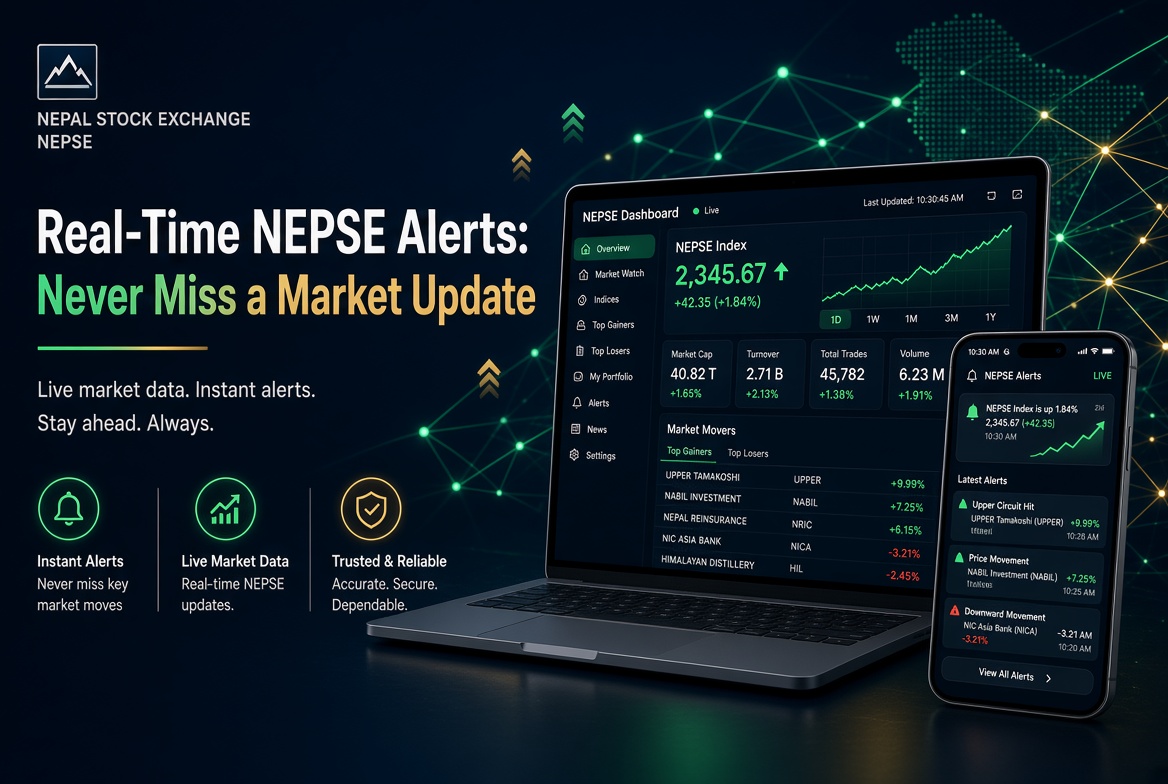
NepseAlerts is built for exactly this problem. It is a real-time market intelligence platform for NEPSE, and you can create a free alert with a simple account.
On the platform, you can set alerts for price and volume movements, company announcements, and market open and close. Besides alerts, you also get tools that help you check the news before you act:
- The NepseAlerts live dashboard shows live prices, market breadth, and sector performance, with visible timestamps so you know how fresh the data is.
- The announcements page collects official company notices in one place.
- The floorsheet shows who traded and how much.
- The share calculator helps you work out your costs and returns.
In short, an alert tells you something happened, and these tools help you understand why.
Real-Life Scenarios: How Alerts Help
Scenario 1: Buying at your target price. A commercial bank stock trades at Rs. 450, and you feel Rs. 420 is fair. You set a price alert at Rs. 420 and go back to work. One afternoon it dips and your phone buzzes. Then you place your order right away. Without the alert, you would have seen the dip only after it recovered.
Scenario 2: Protecting your dividend. A company you hold announces a cash dividend. Your announcement alert gives you the book closure date. Since shares take a few trading days to reach your account, you know you must act early. As a result, you stay eligible. Sadly, this is exactly what I once failed at.
Scenario 3: Catching a sudden move. A stock you follow suddenly sees heavy volume. Your volume alert fires, so you open the live dashboard and check the news. You then decide calmly instead of chasing the price.
How to Set Up Real-Time NEPSE Alerts (Step by Step)
Setting up alerts takes about ten minutes.
- Create your account. Go to the NepseAlerts sign-up page and log in.
- Add your watchlist. Next, add both the stocks you own and the ones you are considering.
- Pick the alert type and set conditions. For example, start with a few price alerts and one announcement alert.
- Check your notification settings. In my experience, it is best to choose the channel you look at most often.
- Test and review. Set one test alert first, and then review everything once a month.
How to Choose the Right Real-Time NEPSE Alerts Tool
Not all tools are equal. Here is what I look at before I trust one.
- Data accuracy and speed: first, ask if the data is truly live or delayed. After all, a late alert is not much help. Timestamps on the data make this easy to check.
- Customization: can you set your own prices and conditions? As a result, more control means more useful alerts.
- Delivery channels: check that it can reach you where you actually look.
- Cost: many tools have a free plan with basic alerts. So start free, and pay only when you clearly need more.
- Ease of use: also, if the app is confusing, you will stop using it.
Limitations and Risks to Keep in Mind
Alerts are helpful, but they are not magic. I learned a few things the hard way.
- Alert fatigue: I once set alerts for almost everything. My phone buzzed all day, and soon I ignored even the important ones.
- Overtrading: a notification can make you feel you must act now. But most of the time, you do not.
- Possible data delays: also, even good tools can be slow because of internet or system issues.
- Information, not advice: an alert tells you what happened, not what to do. Investing carries risk, so never invest money you cannot afford to lose.
Best Practices for Using Real-Time NEPSE Alerts
These habits have worked well for me:
- Set only meaningful alerts. Ask yourself, “Will I actually act on this?”
- Combine alerts with research. Check the company’s financials, news, and chart before you decide.
- Review your alerts every month. For example, remove old ones and update prices.
- Keep a long-term plan. In short, let your plan guide you, not your phone.
Quick Checklist: 5 Alerts Every NEPSE Investor Should Set
- A price alert for each stock you own or want to buy
- A company announcement alert for dividends, bonus shares, and book closure
- A volume alert for your top holdings
- A market open and close alert to plan your day
- A watchlist review reminder once a month
Frequently Asked Questions
Are there free NEPSE alert tools?
Yes. NepseAlerts lets you create a free alert. However, other tools may charge for extra features, so read the plan details first.
What types of alerts can I set on NepseAlerts?
You can set alerts for price and volume movements, company announcements, and market open and close.
What is book closure and why should I track it?
Book closure is the date a company closes its shareholder list to decide who gets a dividend, bonus, or right share. If you are not on the list, then you miss the benefit. Since shares take a few trading days to settle, you need to buy well before this date.
Can alerts help beginners in the share market?
Yes. Overall, they help beginners learn how prices move and avoid missing key dates. So start with two or three alerts, and keep learning about each company.
Do I still need to check TMS if I use alerts?
Yes. Alerts only tell you that something happened. Instead, you still need TMS to place orders and MeroShare to apply for issues.
Conclusion
Real-time NEPSE alerts will not make you rich overnight, but they can stop small mistakes that cost real money, like a missed book closure or a good buying price. They let you follow the share market in Nepal without staring at a screen all day.
My advice is simple. Do not set fifty alerts. Instead, start with the five in the checklist and adjust from there.
Finally, if this guide helped, create your free alert on NepseAlerts today and set up your first price alert.
This article is for information only and is not investment advice. Always do your own research before investing.