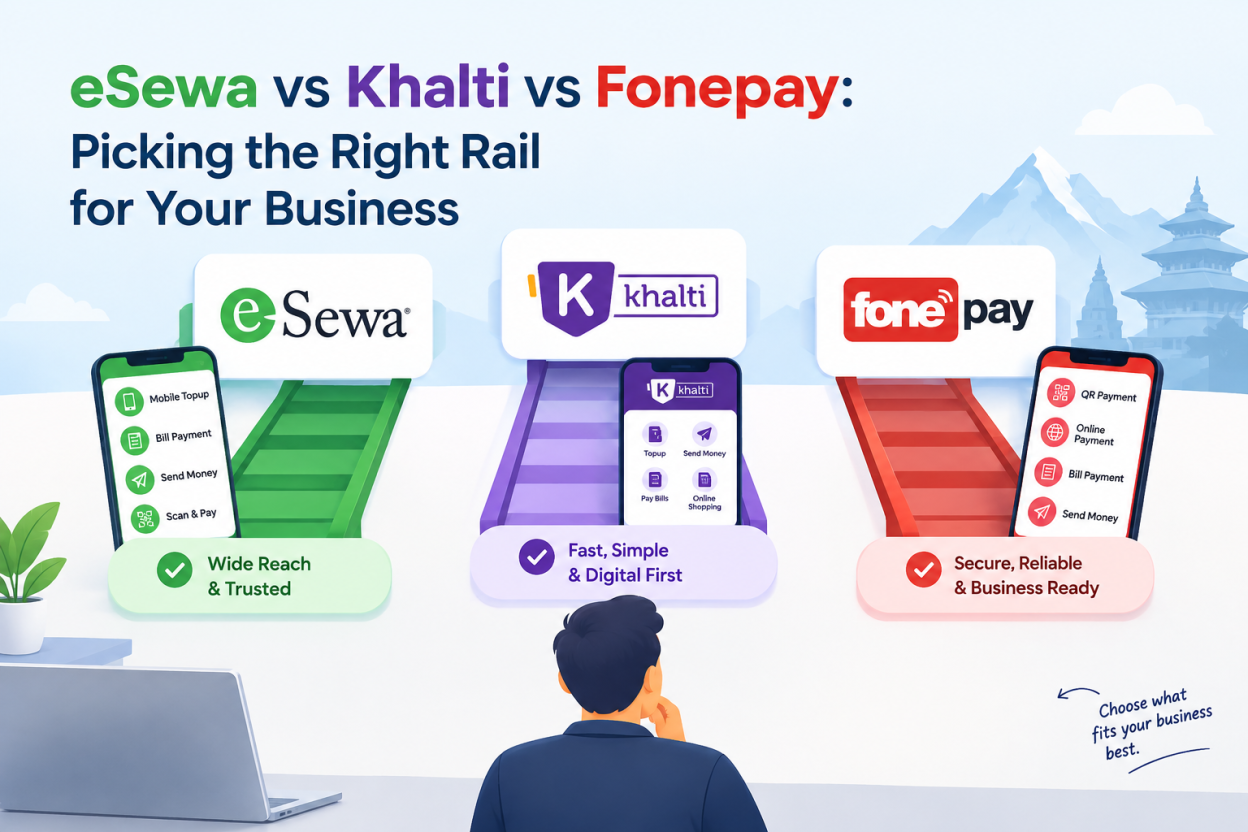
For eSewa vs Khalti for business, eSewa gives you the widest customer reach while Khalti gives you faster approval and a maintained plugin. Fonepay costs least because money settles straight to your bank. Most Nepali stores run eSewa and Khalti together rather than choosing between them.
Choosing between them on fee alone is the mistake. The percentage difference on a Rs 2,000 order is about ten rupees. Meanwhile a two-week approval delay or a settlement model you did not plan for costs considerably more.
So this comparison weighs five things that actually change your month: reach, fees, settlement, approval friction and developer effort.
| eSewa | Khalti | Fonepay | |
| Type | Wallet | Wallet | Interbank QR network |
| Money lands in | eSewa merchant wallet | Khalti merchant wallet | Your bank account |
| Reported merchant fee | 1.5% to 2.5%, varies by agreement | Around 2.0% | Zero to about 1%, set by your bank |
| Approval time | 1 to 2 weeks existing, 2 to 4 weeks new | 3 to 5 business days | Through your bank, varies |
| Test credentials | Requested from support, not self-service | Issued before full approval | Via bank or provider |
| Settlement | You initiate transfer to bank | Wallet, then withdraw | Same day to next working day |
| Maintained WooCommerce plugin | No, repository plugin closed Sep 2025 | Yes, updated May 2025 | Yes, updated May 2025 |
Which wallet do your customers already have?
Reach decides more revenue than fees do. A customer who does not use your wallet abandons the cart entirely, which costs you the whole order rather than two percent of it.
eSewa wins this comfortably. It carries more than 8 million users and over 150,000 merchants, and it is the wallet most Nepali consumers recognise first. For a store selling to a general audience, eSewa is close to mandatory.
Khalti sits second in wallet adoption. Its user base skews somewhat younger and more urban, which matters if you sell to students, tech buyers or Kathmandu professionals rather than a nationwide general market.
Fonepay is different in kind. Because it is the interbank QR network rather than a wallet, anyone with a bank app can pay through it. That gives it reach beyond wallet users, including older and more conservative customers who never adopted a wallet at all.
What the fees actually cost you?
Published merchant rates conflict between sources, which is itself worth knowing. A comparison tool published in April 2026 lists eSewa at 1.5 percent as a standard merchant rate. A developer guide from May 2026 puts eSewa at 2 to 2.5 percent with volume discounts above NPR 5 lakh a month. Khalti is generally reported at around 2.0 percent.
Both can be true, because business category and volume affect what you are offered. Treat any published figure as a starting point and confirm your own rate directly.
Fonepay is the cheap one. Reports range from no merchant fee at all on QR payments to roughly 0.5 to 1 percent depending on the bank. Your rate comes through your bank rather than a public sheet, so ask them.
Put that in rupees before deciding. On a store doing Rs 500,000 a month, the gap between 1.5 and 2.5 percent is Rs 5,000. Real money, but smaller than most owners assume when they agonise over it.
Settlement is where the real difference sits
This is the most under-discussed difference and the one that causes cash flow surprises.
With eSewa, money lands in your merchant wallet rather than your bank account. There is no automatic daily settlement by default, so you initiate the transfer yourself from the merchant portal. Owners who do not know this find a month of revenue sitting in a wallet they forgot to sweep.
Khalti follows the same wallet-then-withdraw pattern. You accumulate a balance and request settlement.
Fonepay behaves differently again. Money moves into your bank account directly, typically same day to next working day, occasionally T plus two. Nothing accumulates in a wallet, so nothing needs sweeping.
If your business runs tight on working capital, that difference matters more than any fee. Money in a wallet you have to remember to move is money not paying your suppliers.
Approval difficulty and how fast you can launch
Every provider asks for broadly the same paperwork: company registration certificate, PAN or VAT certificate, and the citizenship document of the account operator. Limited companies also submit a board resolution or authorisation letter. Khalti additionally asks for a recent tax clearance certificate and an updated logo.
Timelines differ though. Khalti typically issues credentials three to five business days after complete document submission. eSewa runs one to two weeks for existing users and two to four weeks for new sign-ups, although some integrators report faster turnarounds when paperwork is clean.
One warning that catches people. Khalti states plainly that you can integrate and test without full documents, but cannot withdraw anything to a bank account until they are uploaded. Your checkout works, revenue accumulates, and none of it is reachable.
Developer effort has shifted decisively toward Khalti
This changed in the past year and most comparison articles have not caught up.
Khalti has a maintained WooCommerce plugin in the WordPress repository, last updated May 2025. It also issues test credentials before full merchant approval, so development can begin while the application sits in review. Those two facts together can save a fortnight of calendar time.
eSewa is harder now. The widely recommended WooCommerce eSewa plugin was closed by WordPress.org on 5 September 2025 over a licensing and trademark violation, so it cannot be installed fresh. Its sandbox credentials are also not self-service and must be requested from support. Accepting eSewa on WooCommerce today means either a custom integration against the ePay API or an aggregator that bundles it.
The full picture on which plugins remain installable is in our guide to setting up a WooCommerce Nepal payment gateway, including the compatibility problems that appear when a plugin predates the current WooCommerce order storage.
Fonepay also has a maintained WooCommerce plugin, updated May 2025.
Where each one genuinely loses?
Every comparison that finds no fault anywhere is marketing. Here is the honest version.
- eSewa loses on developer experience. No maintained repository plugin, no self-service sandbox, and the longest approval window of the three.
- Khalti loses on reach. It is second in wallet adoption, so running it alone leaves customers unable to pay.
- Fonepay loses on clarity. Payments settle to your bank rather than a dashboard you check daily, and owners routinely check the wrong dashboard, conclude a payment failed and refund a customer who already paid.
- All three lose to cash on delivery in rural markets, which still converts better than any digital rail for first-time buyers.
So which combination should you actually run?
For a general consumer store, run eSewa and Khalti together, plus cash on delivery. eSewa covers reach, Khalti covers the customers eSewa misses and gets you live faster, and cash on delivery covers everyone who does not trust online payment yet.
For high-value goods, add ConnectIPS. Its flat fee of roughly NPR 5 to 20 per transaction beats percentage-based wallets once orders exceed about NPR 1,000, and its transaction limits are considerably higher.
For a service business invoicing a handful of clients monthly, one wallet plus a bank transfer option is enough. Do not build three integrations to process forty payments a month.
Hosting notes for a multi-gateway checkout
Running two or three gateways multiplies the number of callbacks your server has to receive correctly. Each provider posts back independently, and each expects a response.
Keep the callback URLs exempt from page caching, because a cached callback response produces orders that were paid but never marked as such. Keep SSL valid, since no gateway will post to an unencrypted endpoint. And remember that checkout pages cannot be cached the way a blog post can, so they hit PHP and the database on every request.
For stores running multiple gateways, web hosting in Nepal with local billing keeps your own vendor costs in rupees and puts the server closer to the customers completing those payments.
Frequently asked questions
Khalti is easier to launch, with approval in three to five business days, a maintained WooCommerce plugin and test credentials issued before approval. eSewa reaches more customers. Most small businesses should run both rather than choose, since the cost of adding the second is one integration.
Fonepay, generally. Reports range from no merchant fee to about 1 percent depending on your bank. ConnectIPS is cheapest for large payments because it charges a flat NPR 5 to 20 rather than a percentage.
Khalti typically takes three to five business days from complete document submission. eSewa takes one to two weeks for existing users and two to four weeks for new sign-ups. Fonepay goes through your bank, so timing varies by institution.
You can build and test, but not collect. Khalti issues test credentials before approval so development can proceed. Neither provider will release funds to your bank account until your documents are complete and verified.
If they paid by scanning a bank-issued QR, the money moved over Fonepay rails into your bank account rather than a wallet balance. Check your bank’s merchant dashboard before treating it as a failed payment or issuing a refund.
No. Two wallets plus cash on delivery covers most consumer stores. Add Fonepay when you want to reach customers who use bank apps rather than wallets, and ConnectIPS only when your average order value is high enough for flat fees to win.