
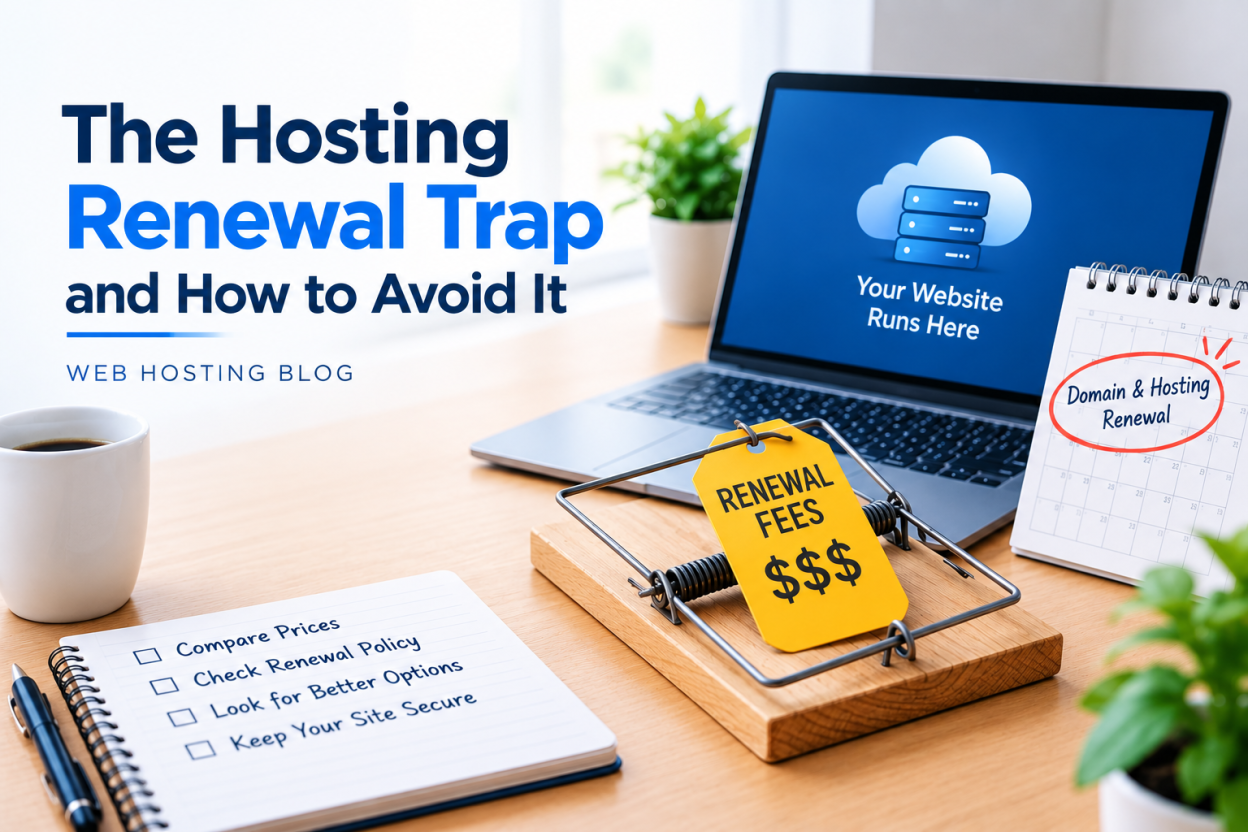
The Hosting Renewal Trap and How to Avoid It
Quick answer
A web hosting renewal price increase happens because the advertised rate is a first-term promotion, not a standing price. When the term ends, you pay the standard rate, which is often several times higher. Avoiding it means finding the renewal figure before you buy and pricing three years, not one.
You bought hosting at a price that seemed too good to argue with. Twelve or thirty-six months later, an invoice arrived for several times that amount. Nothing went wrong and nobody misled you in a way that would stand up in court. You simply bought a promotional rate and then paid the real one.
This article explains how the mechanic works, how to price around it, and what to do if the bill has already landed.
Why the web hosting renewal price increase happens
Customer acquisition in hosting is expensive and competitive. The industry’s answer has been to compete almost entirely on the first-term price and recover margin on renewal.
Three things make it work.
Search results rank by advertised price. Comparison sites and ads display the introductory figure. A provider showing its true standing rate looks expensive next to one showing a promotion, so almost nobody does.
Switching is harder than it looks. Migration takes effort, DNS changes feel risky, and domains registered with the host are locked for 60 days after registration or transfer. Inertia means most customers renew once even when they intend not to.
Renewal is often automatic. Auto-renew is usually on by default, and the charge frequently lands before the customer has evaluated it.
None of that is fraud. It is a pricing model that depends on you not doing arithmetic before you buy. For the tier-by-tier bands underneath it, see how much web hosting should cost.
What the increase actually looks like
Promotional discounts in this industry commonly run to [VERIFY: state a checked range across named providers, with a verification date] off the standard rate. That means the renewal can be several times the first-term price for the same plan on the same server with the same resources.
Three related charges usually arrive at the same time.
The domain. Frequently free in year one and charged at the standard registration rate thereafter. That rate also varies by extension, and .com is not the most expensive.
The SSL certificate. If the host bundled a paid certificate rather than a free one, it renews too.
Backups or security add-ons. Sometimes included as part of the promotion and billed separately afterwards.
The result is a second-year invoice that bears little resemblance to the first.
How to price around it before you buy
The calculation takes two minutes and it is the single most useful thing in this article.
- Write down the introductory monthly rate and the term required to get it.
- Multiply out the full first term. That is your committed spend.
- Find the renewal rate for the same plan. If it is not on the page, ask support in writing and keep the reply.
- Multiply the renewal rate across the remaining months to reach 36.
- Add the year-two and year-three cost of the domain, the certificate, and any other year-one freebie.
- Divide the total by 36.
That figure is the plan’s real monthly cost. Compare providers on it.
The outcome is often counterintuitive. A plan advertised at a very low rate renewing steeply frequently costs more over three years than a plan advertised higher renewing gently. The headline and the total invert. This is the same trade-off we examine in what cheap hosting actually costs you.
Questions to ask before checkout
Ask these in pre-sales chat and keep the transcript.
- What is the renewal price for this exact plan, on this exact term?
- Is that price locked, or can it change again at the following renewal?
- Is the domain free only for the first year, and what is the renewal rate?
- Is auto-renew on by default, and how do I turn it off?
- What is your refund policy, and does it exclude the domain registration fee?
- If I prepay three years and cancel in month six, what is refunded?
A provider that answers all six clearly is telling you something about how it does business. A provider that deflects on the first one is telling you something too.
What to do when the renewal invoice has already arrived
You have more room than you think, and you should act before the charge processes rather than after.
Ask for a retention rate. This is the single most effective step and almost nobody takes it. Hosting companies have retention offers, and they are usually available on request rather than automatically. Contact billing, say you are evaluating alternatives, and ask what they can do. A meaningful discount is common.
Downgrade instead of leaving. If your site never approached the resource ceiling, a lower tier may serve it identically for less.
Shorten the term. If a three-year renewal is the problem, an annual renewal costs more per month but gives you an exit in twelve months instead of thirty-six.
Turn off auto-renew now. Do this even if you plan to stay, so the decision is yours rather than the calendar’s.
Separate the domain from the hosting. If the domain is the sticking point, transfer it to a registrar with transparent renewal pricing. Note the 60-day lock rule before you plan the timing, which how to transfer a domain covers step by step.
If you leave, take a full backup first. Generate and download a complete account backup before cancelling, not after. Access can end at the moment of cancellation.
How to spot a host that does this to you again
Signals worth checking on the next provider’s site.
- Renewal price shown on the plan page, not only in the cart.
- A pricing or terms page that states standard rates separately from promotions.
- Domain renewal rates published on the domain page.
- Refund policy that says plainly whether the domain fee is excluded.
- Auto-renew clearly toggleable in the client area.
- No countdown timer that resets on page reload.
The last one is a small thing that reveals a lot about how a company treats its customers. If you are shortlisting replacements, how to choose a web host and the best web hosting comparison for 2026 both show renewal pricing next to intro pricing.
Where we stand
An honest position matters more than a clever one here, because this article criticises a practice we participate in.
Bisup sells hosting at a promotional first-term rate and renews at a standard rate, like the rest of the industry. [BISUP: state the entry plan’s introductory rate, the renewal rate, and the term, for each currency, once the price contradiction is resolved].
What we think is fair to hold any provider to, ourselves included:
- The renewal rate should be visible before checkout, not at it.
- The domain renewal rate should be published on the domain page.
- Auto-renew should be easy to turn off.
- A full account backup should be downloadable by the customer at any time, without a support ticket.
You can hold our own web hosting plans to all four.
[BISUP: confirm which of those four are true today. Do not publish this list until they are. If one is not, fix it before publishing rather than claiming it.]


